

Frequently Asked Questions
FuelMaster Plus Software
This tutorial assumes:
- You have opened an installed version of FMPlus.
- You have permission to add Customers.
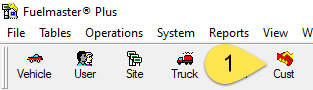
1. Select Cust (Customer).
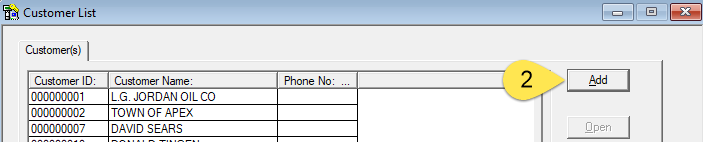
2. Select Add.
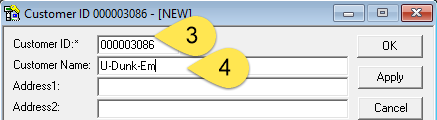
3. Enter a Customer ID.
4. Enter a Customer Name.
5. Select OK.
This tutorial assumes:
- You have opened an installed version of FMPlus.
- You have permission to add products.
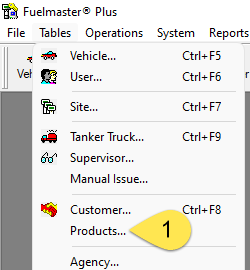
1. Select Tables > Products.
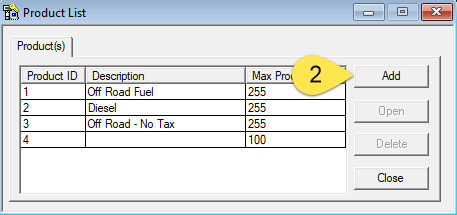
2. Select Add.
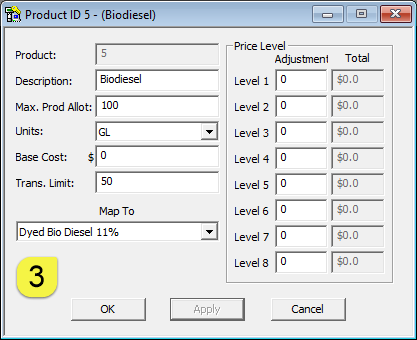
3. Enter or select the desired Product ID, Description, Max Product Allotment, Units (of Issue), Base Cost, Trans. Limit and Map To for the new product.
- Note: Map To (used in concert with credit card functionality) allows you to select the Product the credit card network requires. If you’re having issues finding the right Product, please call our Customer Satisfaction Center for assistance.
5. Select OK.
This tutorial assumes:
- You have opened an installed version of FMPlus.
- You have permission to add vehicles.
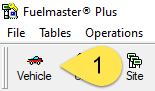
1. Select Vehicle.
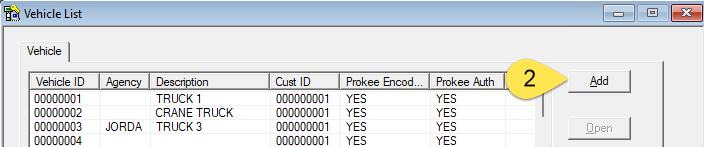
2. Select Add.
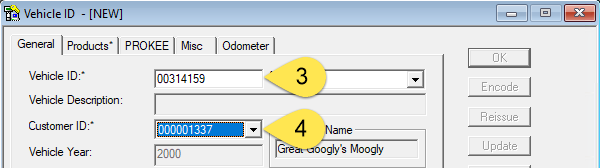
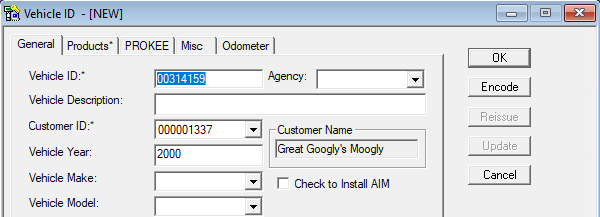
3. On the General tab, enter a Vehicle ID
- Note: Vehicle IDs are unique and unable to be modified once the vehicle is created. Choose wisely!
4. Select a Customer ID from the dropdown menu.
5. On the Products tab, select all applicable Products.
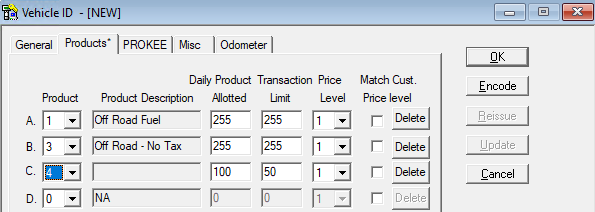
- At this point, the other tabs will open and allow you to finish configuring your vehicle, including encoding if necessary.
6. Select Ok.
This tutorial assumes:
- You have opened an installed version of FMPlus.
- You have permission to add users.
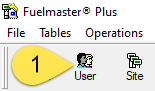
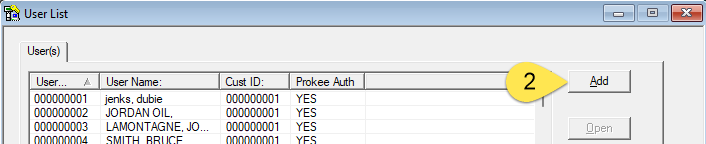
1. Select User.
2. Select Add.
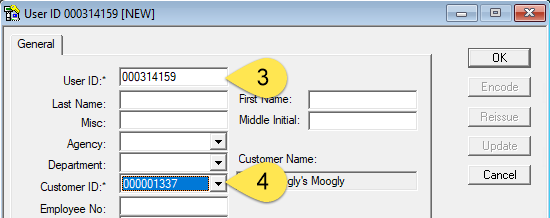
3. Enter a User ID.
- Note: User IDs are unique and unable to be modified once the user is created.
4. Select a Customer ID from the dropdown menu.
5. Select Ok.
This tutorial assumes:
- You have opened an installed version of FMPlus.
- You have permission to add sites.
- You know your site’s IP Address or Phone Number
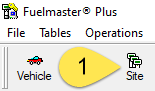
1. Select Site.
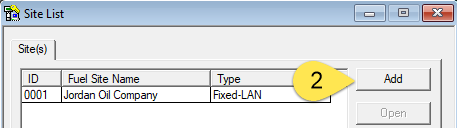
2. Select Add.
3. Enter a Site ID.
- Note: Site IDs are unique and unable to be modified once the user is created.
4. Enter an FMU Type.
5. Select the Connection Type dropdown and select phone or LAN connection.
6. Select the Configure button.
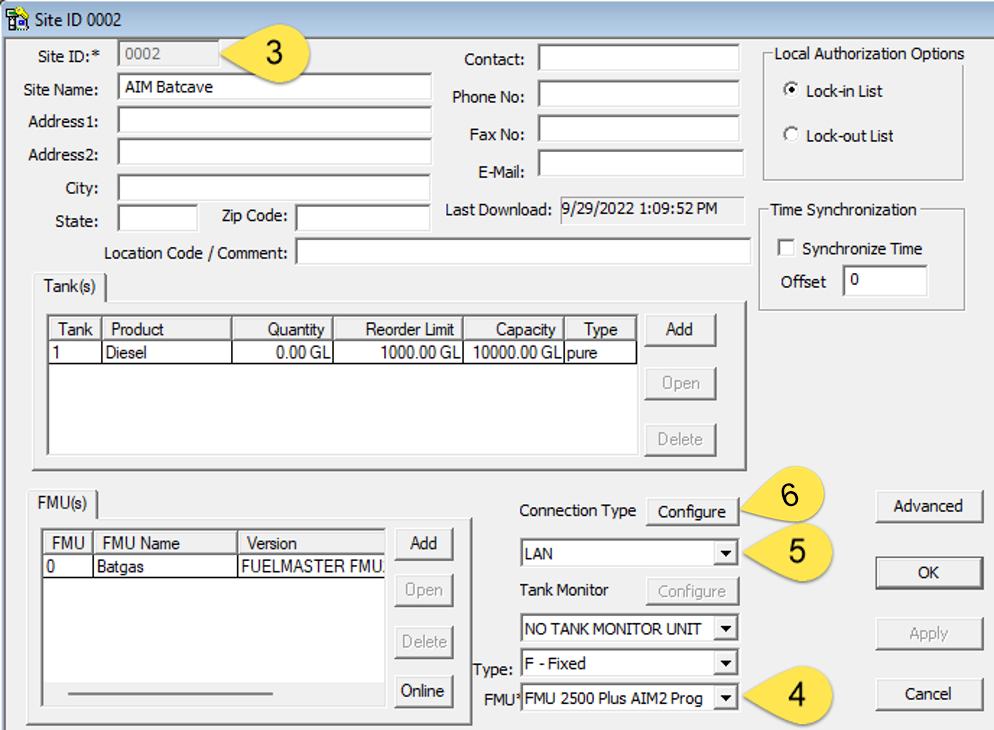
7. Configure your connection:
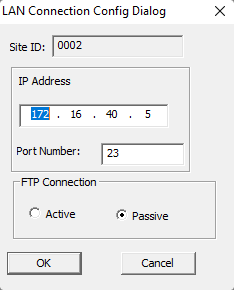
- LAN: Configure the IP address assigned to the FMU.
- Phone: Configure the phone number assigned to the FMU.
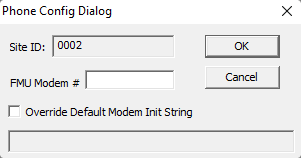
8. Select OK; then, select OK again.
This tutorial assumes:
- You have opened an installed version of FMPlus.
- You have permission to access sites and FMUs
1. Select Site.
2. Select Site to which you want to add an FMU, and select Open.
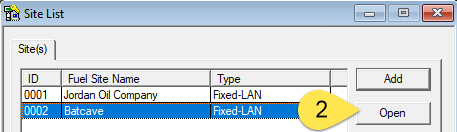
3. In the FMU(s) section, select Add.
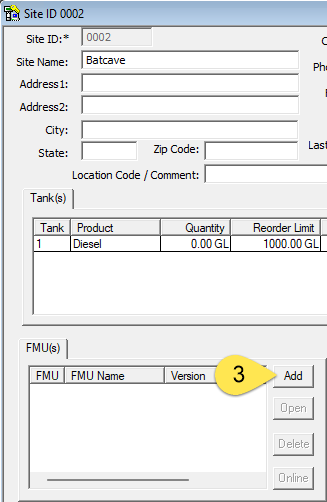
4. Enter the FMU Name.
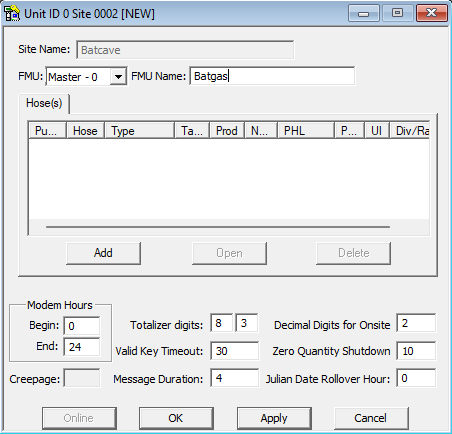
5. Select Ok.
This tutorial assumes:
- You have opened an installed version of FMPlus.
- You have permission to access sites and add tanks.
1. Select Site.
2. Select Site to which you want to add a tank, and select Open.
3. In the Tank(s) section, select Add.
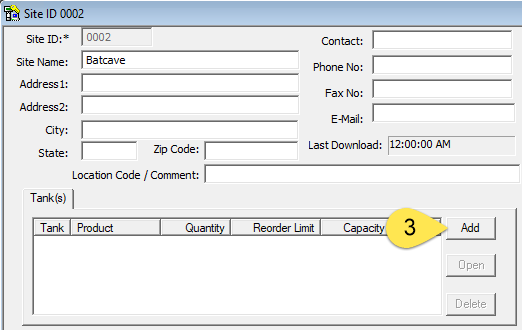
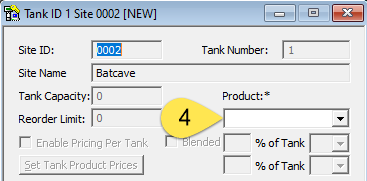
4. Select the Product the tank will hold from the dropwdown menu.
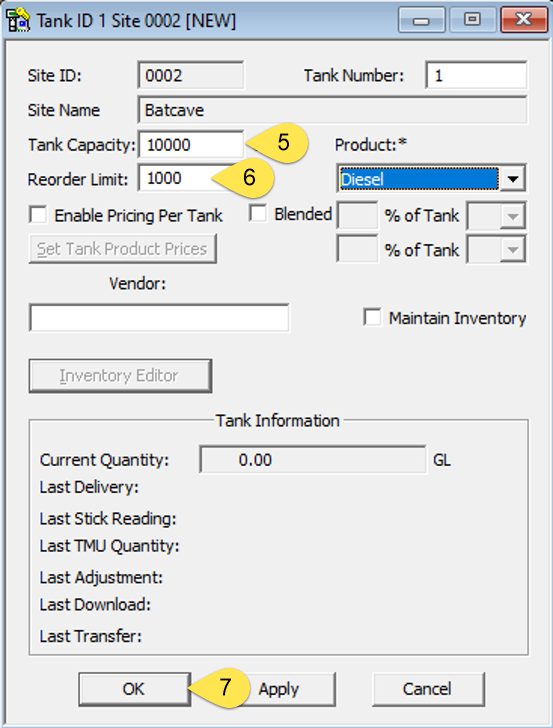
5. Enter the Tank Capacity
6. Enter the Reorder Limit of the tank.
This tutorial assumes:
- You have opened an installed version of FMPlus.
- You have permission to access sites and add hoses.
1. Select Site.
2. Select Site to which you want to add a Hose, and select Open.
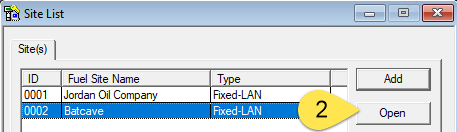
3. In the FMU(s) section, select the FMU.
- FMU: FuelMaster Unit
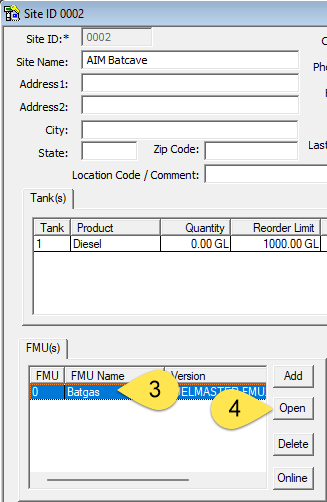
4. Select Open.
5. In the Hose(s) section, select Add.
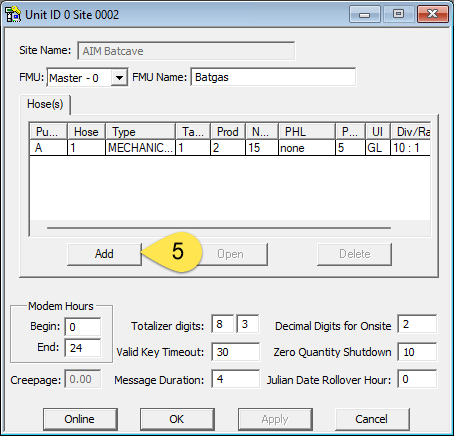
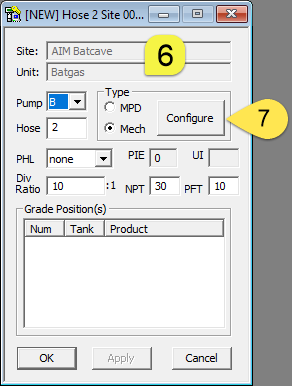
6. Add information on the Pump Position, the Hose Number, the PHL, the NPT, and the PFT.
- Pump Position: This letter usually corresponds to the hose number. A=1, B=2, etc.
- Hose Number: The number hose at the fuel island.
- PHL: Pump Handle – describes how the FMU controls the dispenser. If you’re unsure of what this should be, please contact our Customer Satisfaction Center.
- NPT: No Pulse Timeout – number of seconds the FMU should wait to see quantity information after a transaction has begun.
- PFT: Pump Finish Timeout – number of seconds the FMU should wait to see if more quantity information is coming after the last update.
7. Select whether the pump is a Mechanical or MPD (Multi-Product Dispenser) (blended) and select Configure.
This tutorial assumes:
- You have opened an installed version of FMPlus.
- You have permission to add sites.
- You know your site’s IP Address or Phone Number
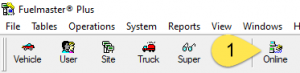
1. Select Site.
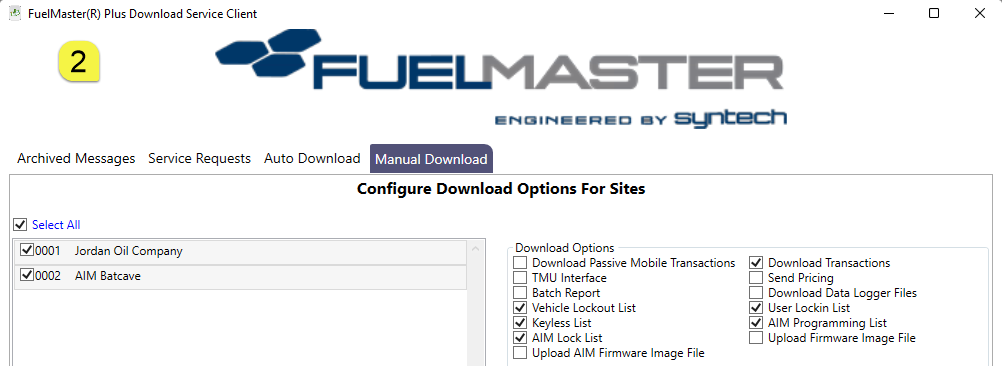
2. Select the Site(s) to which you want to communicate, as well as your Download Options.
- Tip: Customers that do not use credit cards to authorize fuel do not need to select the Batch Report or Send Pricing options.
3. Select Connect.

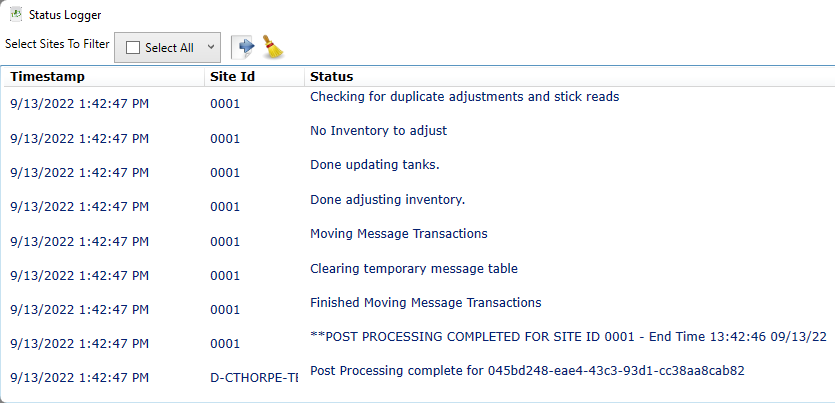
The Status Logger window will open. Once you see **POST PROCESSING COMPLETED..**, the process is complete.
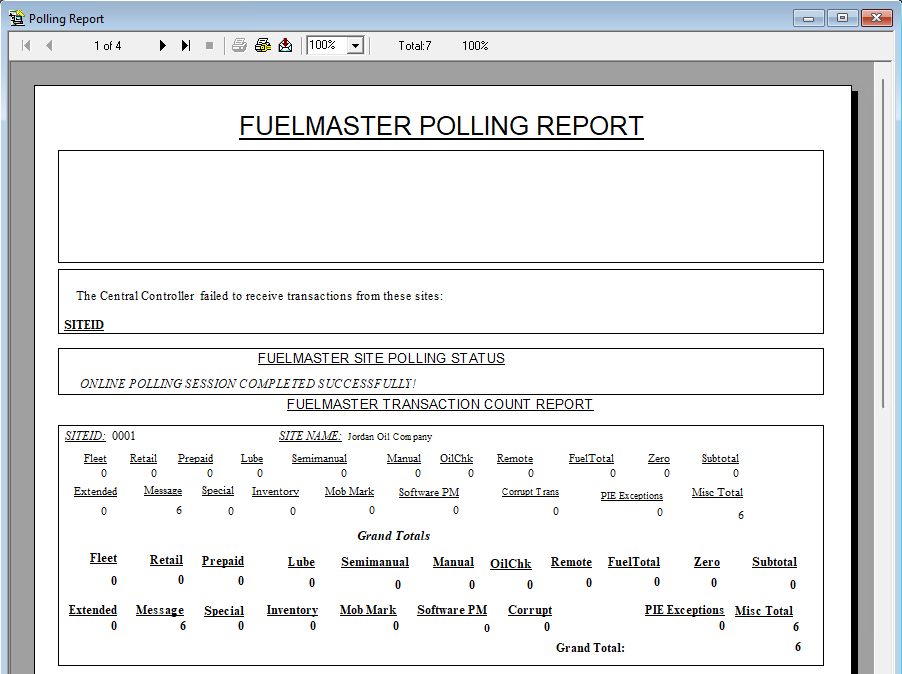
A Polling Report will appear in the software. You should see a message saying, ONLINE POLLING SESSION COMPLETED SUCCESSFULLY! and a breakdown of the transactions downloaded from the FMU.
This tutorial assumes:
- You have opened an installed version of FMPlus version 5.3.3.0 or greater.
- Your export is set up in the proper format and to the proper location.
- You have downloaded transactions successfully.
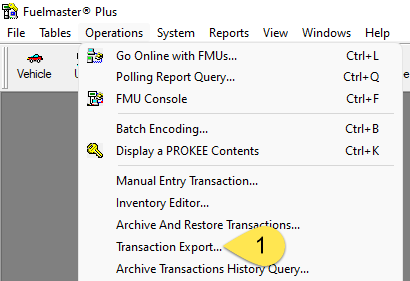
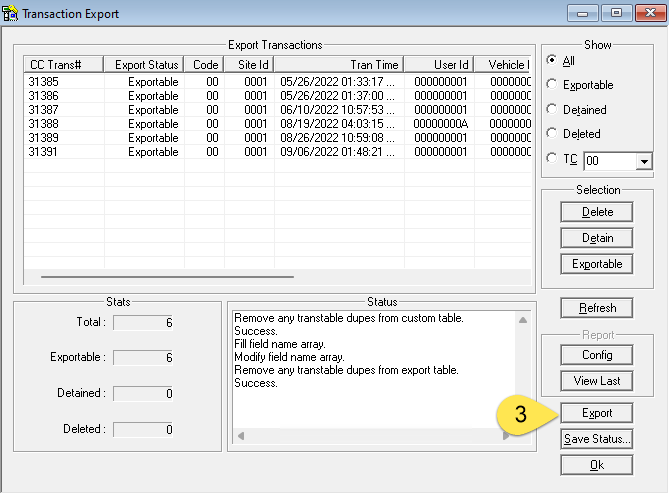
1. Select Operations > Transaction Export…
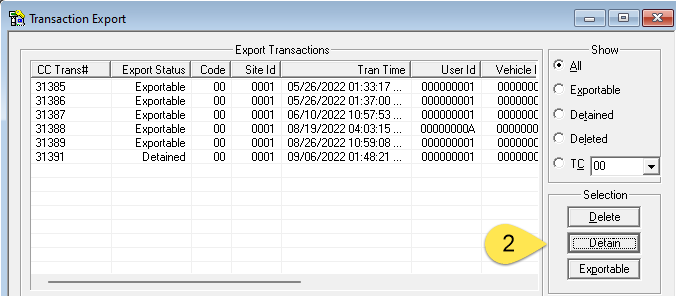
2. Use the Selection buttons to change the status of transactions and curate a list of transactions for export. By default, all transactions that appear are considered Exportable.
3. Select Export.
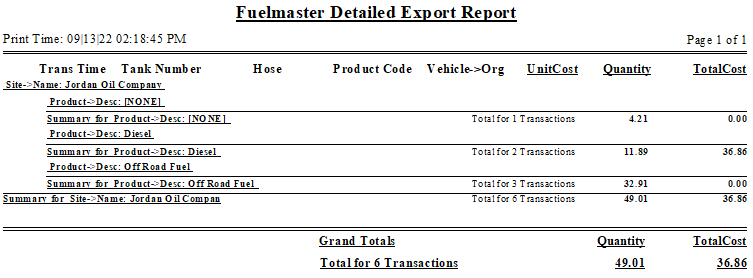
- Once complete, an Export Report identifying the quantity of transactions exported if successful will appear.
This tutorial assumes:
- You have opened an installed version of FMPlus.
- You have permission to add operators.
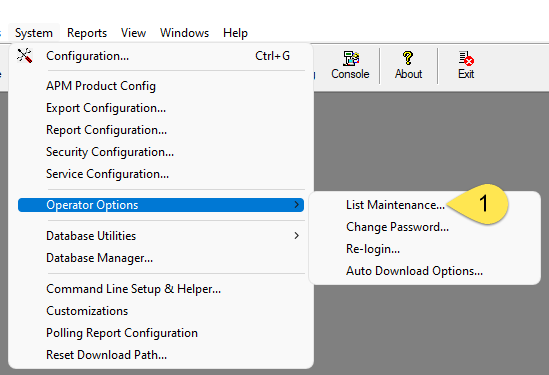
1. Select System > Operator Options > List Maintenance.
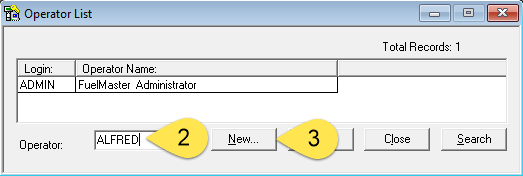
2. Enter Operator Name.
3. Select New.
4. Add any information on the General tab that you’d like.
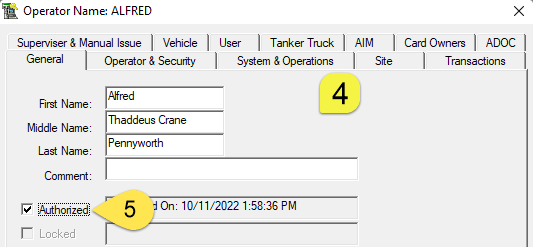
5. Select the Authorized checkbox.
- Note: Operators may be created in software without being authorized; however, those operators will be unable to use the software.
6. Select the proper permissions for the Operator’s role.
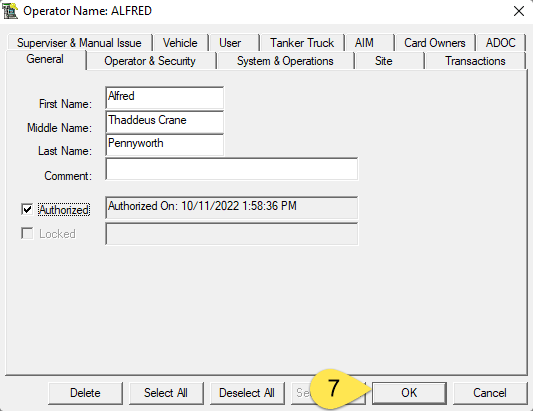
- Note: For an everyday software user, we recommend Select All. If more granular permissions are desired, go through the tabs and customize as desired. If any questions arise about what certain permissions do, please call out Customer Satisfaction Center

7. Select OK.
This tutorial assumes:
- There is another software user with proper permissions who can successfully log in to the FMPlus software. If this is not the case, please contact Syntech’s Customer Satisfaction Center at 1-800-888-9136 x2 or at support@myfuelmaster.com.
- The software is installed on a machine you can access.
1. Have another software user log in to the software other than the user whose password needs to be reset.
2. In the System menu, select the List Maintenance option under the Operator Options sub-menu.
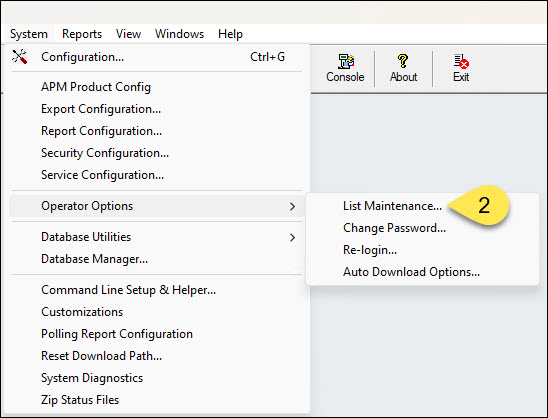
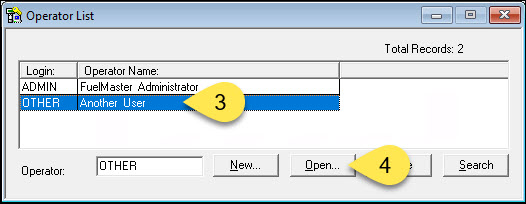
3. Select the user whose password needs to be changed.
4. Select the Open button.
5. Select the Set Password button.
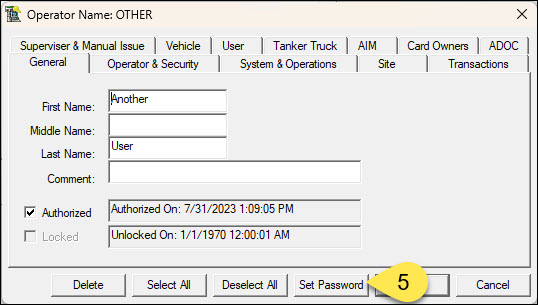
6. Enter and confirm the new password.
7. Select OK.
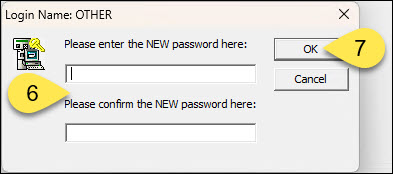
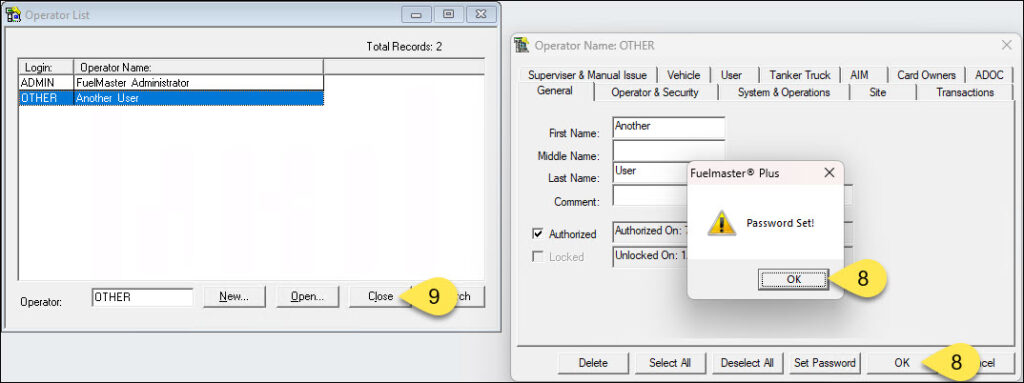
8. Select the OK button twice more.
9. Select the Close button to exit all windows.
10. Exit the software and log back in with the new password.
1. Is the encoder plugged in?
- If not, plug it in.
2. Is the red light on top of the encoder lit?
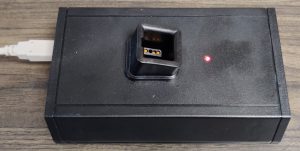
- If not, there’s either something wrong with the encoder or the cable.
- The cable is a standard USB-A to USB-B cable. Replace the cable and try again.
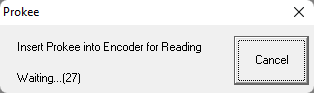
3. Can you read a prokee/smartcard, but not write?
- In your software, click the Prokee button.

- If the software offers to read the key, close the software and reopen.
4. Is the encoder an ARM7 verison?
- Turn the encoder over and look at the silver label. It should read ARM7, as below.
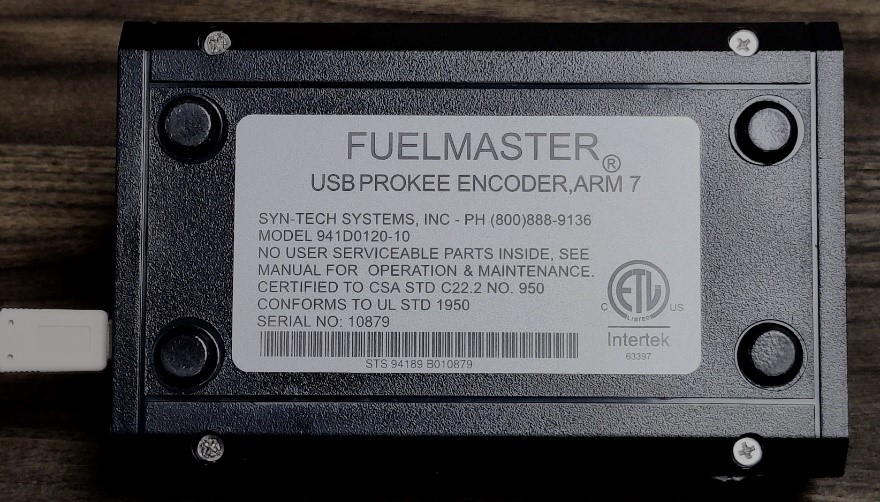
- If Not, replace the encoder with an ARM7 version.
5. Are the encoder drivers installed?
- Use this link for instructions and to download the drivers.
6. Will the encoder work in another USB port?
- Close the software.
- Using another set of ports is recommended – so move from the front of the PC to the back or from the back to the front.
- This is the resolution for encoder issues where the software immediately goes unresponsive and crashes.
- Reopen the software and test.
1. Encoder drivers are available on our website at https://www.myfuelmaster.com/download/USBEncoderInstall.zip.
2. On the bottom of the encoder, ensure the label reads USB Prokee (or Smartcard) Encoder, ARM7. If this is not the case, please contact the Syntech Customer Satisfaction Center for a replacement.
3. Open the FuelMaster Plus software, and view the version.
4. Click the About button.
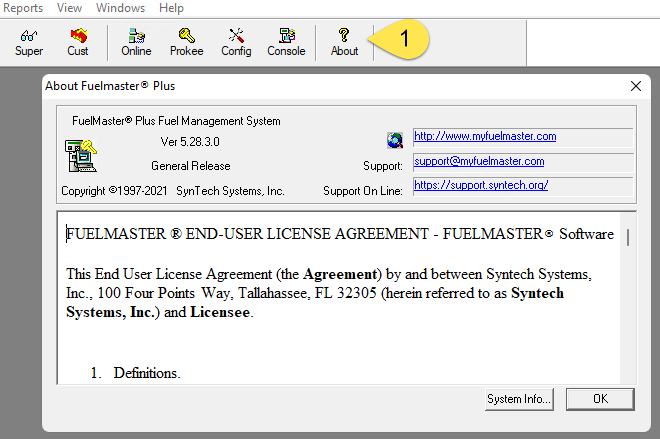
- If your version of software is older than 5.26.3.0, select Config and ensure the encoder type is set to USB.

5. Close the software.
6. Open a File Explorer window and browse to C:\Program Files (x86)\Syntech\FuelMaster Plusfolder.
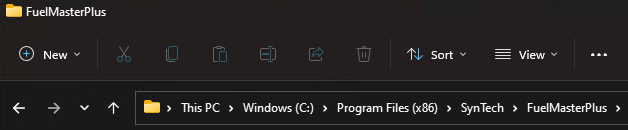
7. Create a folder named Signed Encoder Drivers?
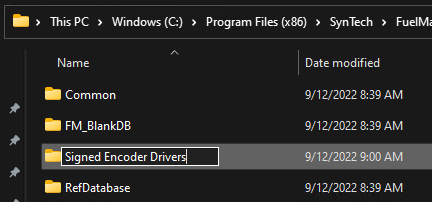
8. Copy the encoder driver files downloaded from myfuelmaster.com into this folder.
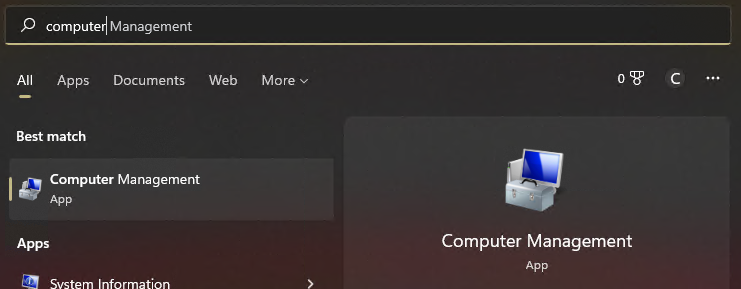
9. Open the Computer Management app. This may need to be run as administrator to install drivers.
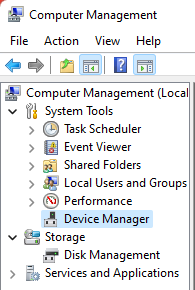
10. On the left side, select Device Manager.
11. Under the Other devices section, find and select the SYN-TECH EN-PR 200 or SYN-TECH EN-SC 200.
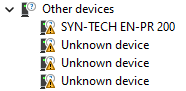
12. Select Update Driver button.
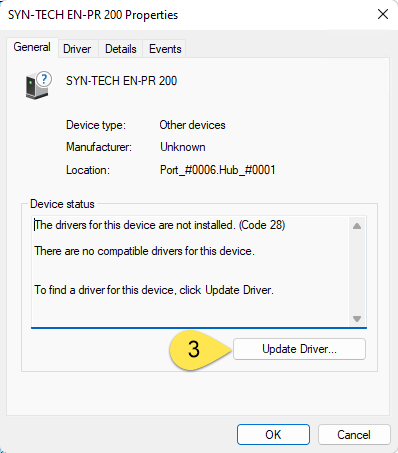
13. Select Browse my computer for drivers.
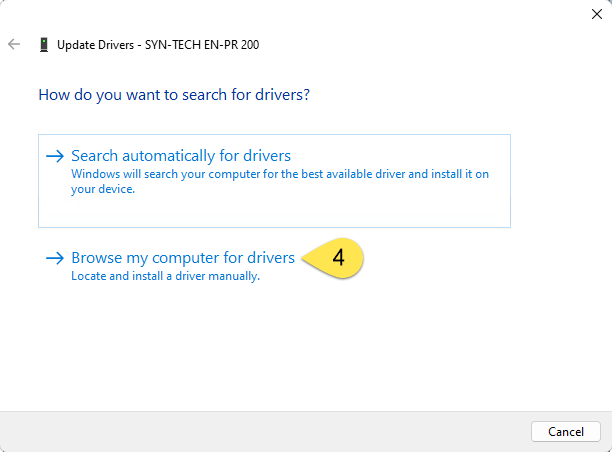
14. Select Browse…
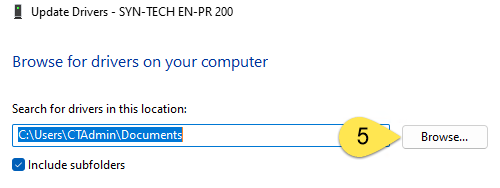
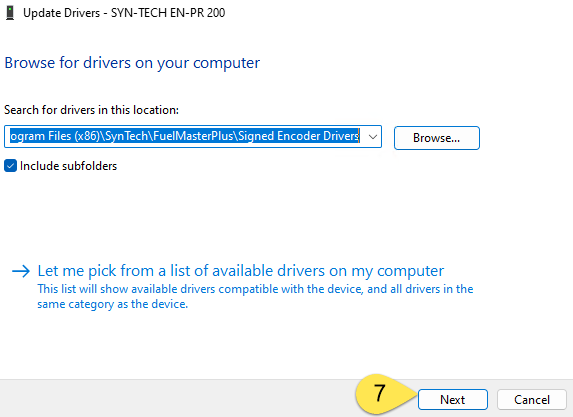
15. Browse through the folder levels to find the path from Steps 5, then click OK.
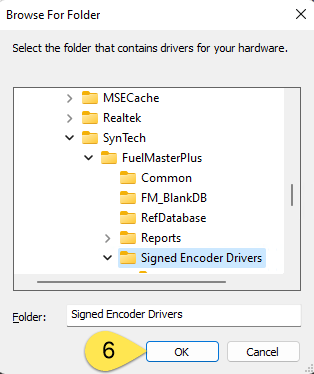
16. Click Next.
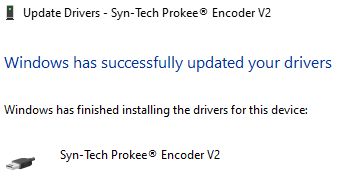
17. Your computer may ask you to verify the driver installation, but when done, you should see that the driver has been installed successfully.
Many apparent connection issues are actually issues with the FMDownload Service. Please check the PC the Service runs on to ensure it’s functional. Further information on the Service can be found here.
Find your IP.
1.Select Site.
2.Select the site for which you need the IP address.
3.Select Open. Depending on settings, this button may be partially obscured.
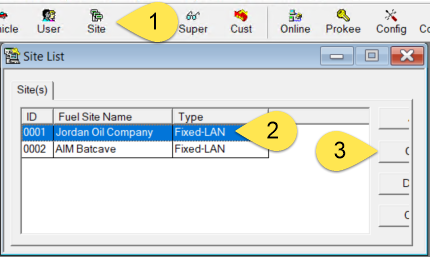
4.Select Configure.
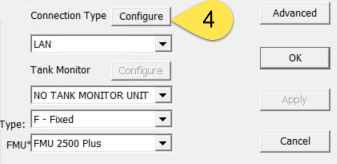
5.The IP address will be in the middle of the LAN Connection Config Dialog box.
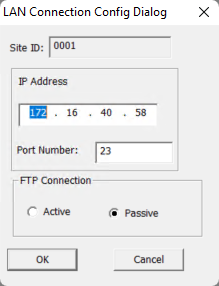
Basic Troubleshooting
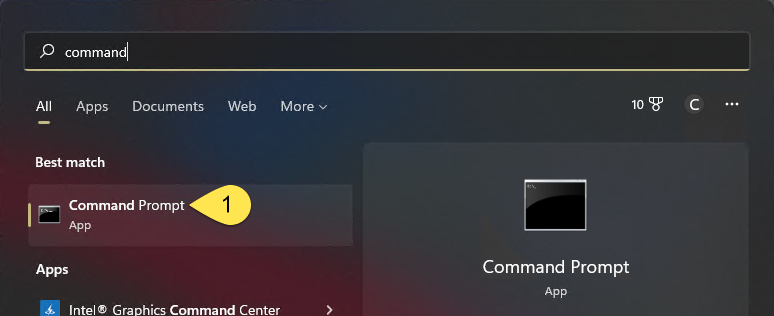
1.In the Windows Start menu, search for and open Command Prompt.
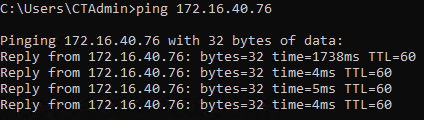
2.Type ping IP ADDRESS in the Command Prompt window, where you substitute the address from the last section.

You should see a good reply come back, like this:
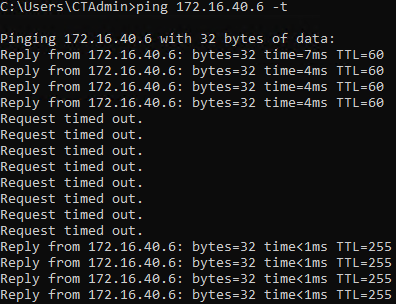
3.If your ping is inconsistent and looks like the below, contact your IT team. We have seen download issues occur with drop rates as low as 10%.
4.If you receive a Destination host unreachable message, contact your IT team for further assistance.
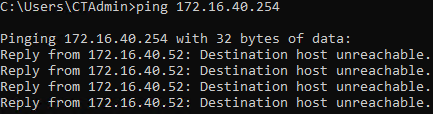
5.If you receive a Request timed out message, please contact us for further assistance.
6.If the reply is good, as in Step7, re-run the test with a -t at the end; then reboot your FMU. you should see a gap as below:
If there’s no gap, another device may have the IP address typically reserved for the FMU. the MAC address of the FMU should always start with F8-F7-FF. Contact your IT team for further assistance if this is the case.
FMPlus (Legacy) Software does not respond well when users utilize scaling of display settings. Typically, you’ll see buttons cut off at the side of the screen, as shown below:
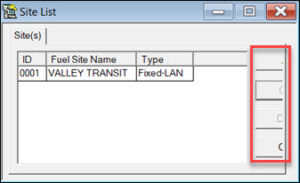
This behavior can be changed by overriding the DPI scaling behavior. This allows you to keep your other scaling while having all buttons available in the FuelMaster software.
1. Ensure the FuelMaster Plus software is closed.
2. Right-click on the FuelMaster Plus icon and select the Properties option.
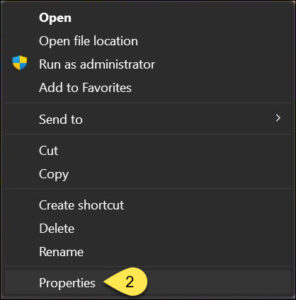
3. Select the Compatibility tab.
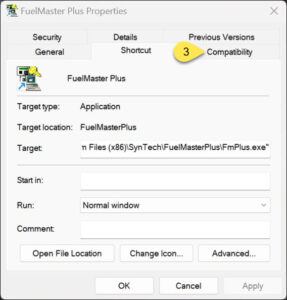
4. Select the Change high DPI settings button.
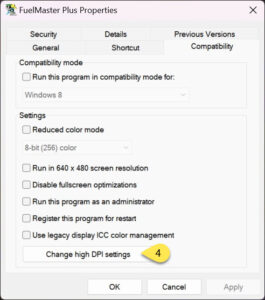
5. Select the Override high DPI scaling behavior checkbox.
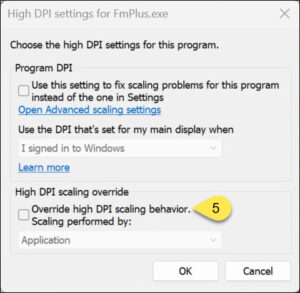
6. Select the System option from the dropdown menu.
7. Select OK.
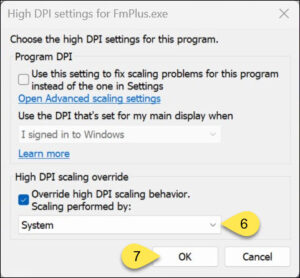
8. Select the Apply button, then close out of the Properties window.
1.Open the FuelMaster Plus Software.
2.Find the report you would like to export.
3.Select your preferred options and click View Report.
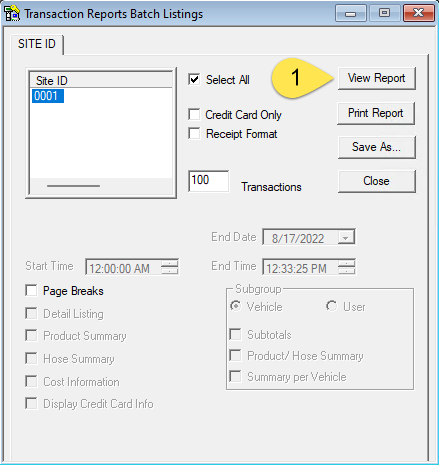
4.Once the report is open, click the Export icon, which looks like an envelope.
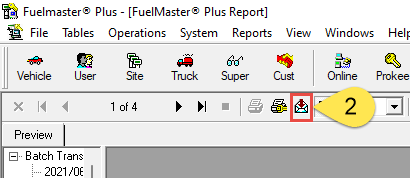
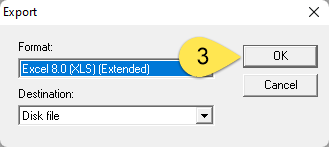
5.In the Export window that comes up, you may choose any of the formats listed. The Destination should be Disk file. Click OK.
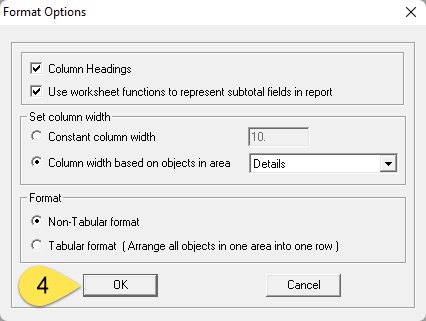
6.If a Format Options window comes up, choose your options, then OK.
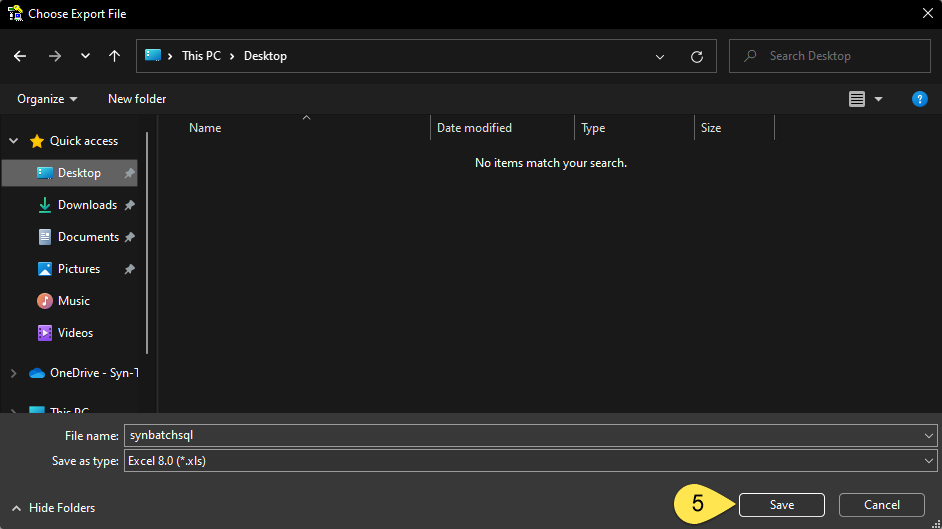
7.Browse to the location where you want to export the report, then click Save.
8.Browse to the location to find your report.
The following are manuals for the use of the FMPlus software:
FuelMaster Plus FMUs
1.Insert the Supervisor’s Key.
2.Select B for Issues.

3.Select C for Pumps.

4.Select A for shutdown Pump or B for Reenable.

5.Shutdown – select the hose you want to shutdown or 0 for all.

6.Reenable – select the hose you want to reenable or 0 for all.

The Count Test is performed to:
- Verify the dispenser doesn’t record quantity when the dispenser is resetting and not pumping fuel.
- Determine the divide rate (number of pulses per gallon or liter) of each pulser.
- Troubleshoot pulser problems.
- Note: If pulses are not received when performing the Count Test, the FMU may be tested (see step 11) to verify it is sending power to and receiving pulses from the pulser.
- Note: If pulses are not received when performing the Count Test, the FMU may be tested (see step 11) to verify it is sending power to and receiving pulses from the pulser.
1.Ensure the LCD displays:
FUELMASTER FUEL MANAGEMENT SYSTEM INSERT KEY
HOLD 1 SECOND TO BEGIN
2.Open the Pedestal door and verify Automatic/Manual mode switches are switched up into Automatic.

3.Insert a Supervisor Key into the receptacle.
*SUPERVISOR MENU: 1=RPTS, 2=PM, 3=ODOM, 4=AIM,
A=CONFIG, B=ISSUES, C=DROPS, D=EXIT*
4.Select A for Configuration Menu.
*SUPERVISOR MENU: 1=RPTS, 2=PM, 3=ODOM, 4=AIM,
A=CONFIG, B=ISSUES, C=DROPS, D=EXIT*
5.Select B for Diagnostic test.
*CONFIGURATION: 13:58:47, 03/20/89*
*A=MODIFY, B=TEST, C=TIME/DATE, D=EXIT*
6.Select B for Count test.
1=SW, 2=OUTS, 3-LCD, 4=KEYPAD, A=PROKEE,
B=COUNT, C=POWER FAIL, D=EXIT
7. Observe the following Count Test display. The top row is for hoses 1 through 4, and the bottom row is for hoses 5 through 8.
FMU-2000 FMU-2500
1-4 ->> 0 0 0 0 CNT TEST 1-00000 3-
00000 5-00000 7-00000
5-8 ->> 0 0 0 0 D=EXIT 2-00000 4-00000
6-00000 8-00000
8.Switch the Automatic/Manual Mode Switch for the hose being tested down it Manual (testing one hose at a time).
9.Go to the fuel dispenser and turn the pump reset handle on.
10.Dispense (as accurately as possible) one gallon of fuel.
11.Observe the Count Test display. The 0 (or 0000) display for the hose being tested should count forward the number of pulses received to register one gallon.
- A display of 10 or 00010 (+/-1) indicates a 10:1 pulser.
- A display of 100 or 00100 (+/-10) indicates a 100:1 pulser.
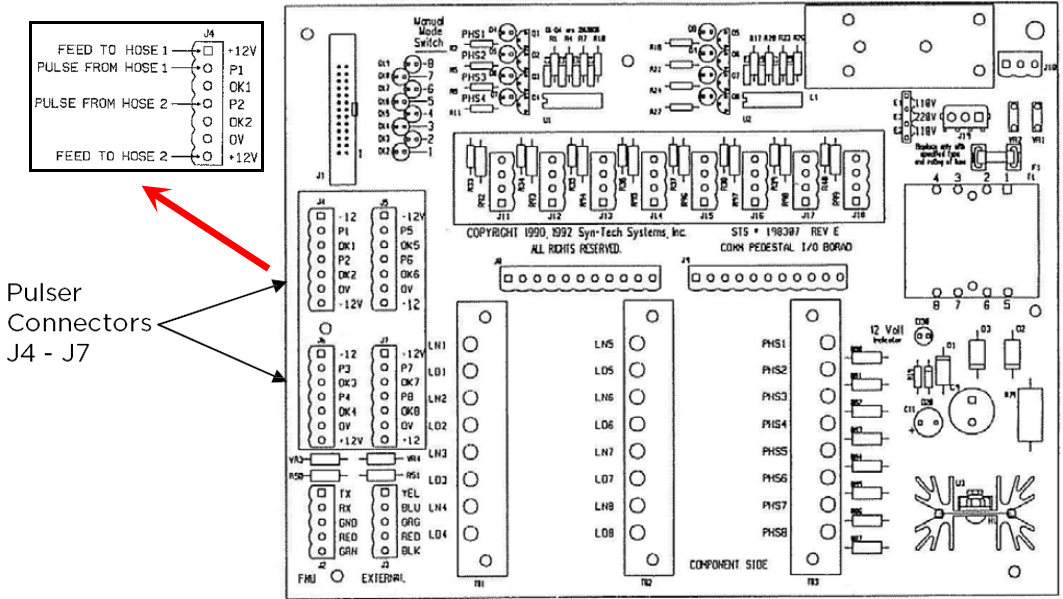
12.If the o (or 00000) display did not increment forward during the Count Test, generate pulses within the FMU to determine the serviceability of the FMU to power the pulser(s) and read the pulses (see figure):
- Ensure all pump reset handles are turned off and remain off for the duration of this test.
WARNING: Electrical shock hazard! Do Not touch any bare conductors.
13.Remove the electrical access panel cover.
14.Ensure the LCD still displays:
FMU-2000 FMU-2500
1-4 ->> 0 0 0 0 CNT TEST 1-00000 3-
00000 5-00000 7-00000
5-8 ->> 0 0 0 0 D=EXIT 2-00000 4-00000
6-00000 8-00000
15.Ensure the applicable pump reset handle is turned off.
16.Disconnect the 7-pin connector (with wires attached) from the applicable J4 through J7 receptacle (J4 for hoses 1 and 2, J6 for hoses 3 and 4, J5 for hoses 5 and 6, and J7 for hoses 7 and 8). Using a jumper wire, momentarily touch a jumper wire between pins +12v (either of the two +12v in each receptacle) and P_(P1 for hose 1, P2 for hose 2, etc.) in the receptacle.
17. The applicable 0 (or 00000) display should increment forward. If the 0 (or 00000) display does increment forward, the FMU is generating pulser power and reading pulses, and a problem exists in the wiring between the FMU and the fuel dispenser pulser, or the fuel dispenser pulser is not functioning.
18.If the 0 (or 00000) display does not increment forward, a problem may exist in the FMU and additional troubleshooting is required with Syntech’s Product Support personnel.
1.Insert the Supervisor’s Key.
2.Select 3 for Odom.

3.Select B for Update.

4.Enter the new odometer.

WARNING: DO NOT attempt this procedure in a rainy environment! The FuelMaster Unit contains live electricity. If you feel uncomfortable at any time, stop immediately and call our Customer Satisfaction Center.
Introduction
Losing the ability to fuel is always an issue that needs to be resolved efficiently. These steps may not always directly resolve your issue but are intended to identify common issues and to gather useful information for our Customer Satisfaction Center.
Can you fuel in manual?
1.Open the pedestal of the FMU.
2.Flip the switch associated with the hose that is malfunctioning down into manual. In the below picture, hoses 3 and 5 are in manual.

3.Attempt to fuel on a malfunctioning hose.
4.If the dispenser doesn’t fuel in manual, it is likely a dispenser issue. Call a dispenser technician to resolve this issue.
What message is displayed on the LCD screen?
Once the fueling is authorized, the LCD should read Dispenser Activated, Turn Pump Handle Off, or Turn Pump Handle On.
If the LCD does not show one of these messages, report what it says to a Customer Satisfaction Center technician.
Check LEDs and cables
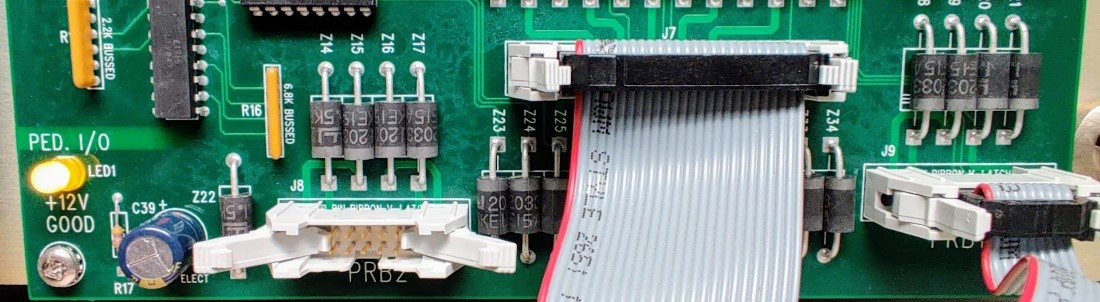
1.On the Sat I/O board in the head of the unit, reset the J7, J9, and J8 (if necessary) cables on both ends – the other end will go into the unit’s pedestal.
Note: The J9 cable should be plugged into the left relay board, and the J8 cable (if necessary) should be plugged into the right relay board.
2.Ensure that the LED1 light is lit on the Sat I/O board.
3.In the pedestal, reseat the black-and-white cable between the relay board and Ped I/O board on both ends.
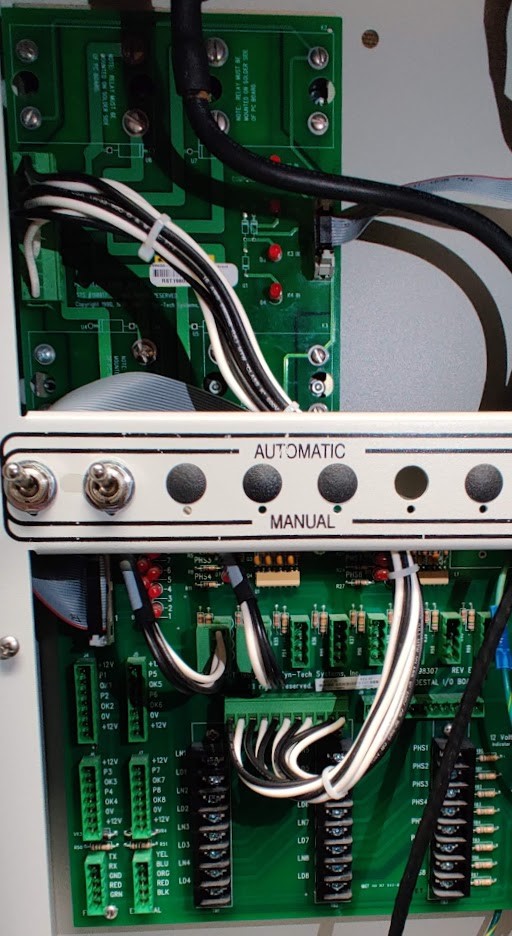
4.On the Ped I/O board, check the red D30 light.
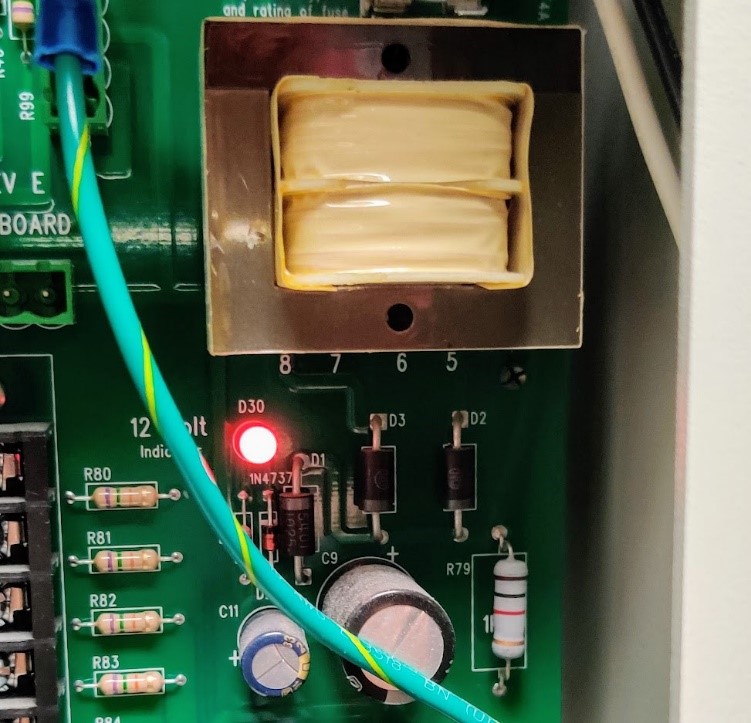
Tip: If it’s not lit, take a picture of the Ped I/O board. Unplug all connectors (except for the terminal blocks) individually, noting if the D30 light is restored for that connector. If so, that component has an issue. If the D30 light doesn’t come back on, contact our Customer Satisfaction Center for further assistance.
If these steps do not resolve your issues, please contact our Customer satisfaction center for assistance, as checking voltages within the FMU may be necessary.
1.Insert the Supervisor’s Key.
2. Select B for Issues.

3.Select A for Manual.

4.Enter a User ID.

5.Enter a Vehicle ID.

6.Enter the Chronometer or Odometer.

7.Enter an Agency ID (if there isn’t one, enter 1).

8.Select a Pump.

9.Begin fueling.
Required Parts
- The keys to the FMU Cabinet
- A small screwdriver, as below.

Procedure
CAUTION! Be very careful when adjusting the contrast – the screw’s range of motion is very small. The mainboard must be replaced if this part is damaged. The purchase of replacement parts may be required if the mainboard is damaged while adjusting the contrast.
1. Without powering the FMU off, open the door to the FuelMaster head.
2. Locate the LCD contrast screw under the main ribbon cable, as below.
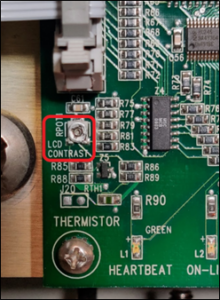
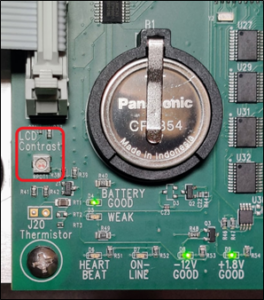
3. Turn the screwdriver to the left to darken or to the right to lighten.
The following are manuals on the usage of FMUs:
FuelMaster Plus Reports
The Activity Reports provide an overview of how FuelMaster® Plus is configured (single site, or, system- wide. Information is broken down by:
1. Deliveries, transfers, and adjustments
2. Fuel transactions by hose number
3. Fuel transaction totals by tank, and
4. Oil check transactions.
Activity Reports quickly allow the user to see:
1. From which tank a product is being withdrawn
2. Number of month-to-date and year-to-date deliveries, adjustments, and transfers whether a hose is activated or unused
3. The type of product being dispensed
4. Unit equivalents: gallons, quarts, etc.,
5. Number of month-to-date and year-to-date units pumped from each hose and tank
6. Number of month-to-date and year-to-date transactions by hose and tank, and
7. Number of month-to-date and year-to-date oil check transactions.
FuelMaster® provides 176 transaction report options based on transactions in batches (e.g. Last ‘100’ transactions) or by groupings (Vehicle, User, Customer, Site).
Reports for transactions by groupings may be based on 16 different database groupings including vehicle ID, user ID, fuel site ID, and customer ID.
The Central Controller operator is prompted to select the type of transaction report, the desired grouping (where applicable), then input the desired date(s) and time(s) range to be covered by the report.
Reports include daily totals for transaction code*, quantity, cost, and period totals for products and dispenser hoses.
This is a 2-digit code used to distinguish types of transactions. Codes beginning with 0 indicate transactions recorded at the Service Island.
1. Codes beginning with 1 indicate transactions entered manually at the Central Controller.
2. 00 or 10 – Fueling vehicle with a Vehicle Key,
3. 02 or 12 – Product removed from a storage tank with a Tank Truck Key (see 08 or 18 below),
4. 03 or 13 – Fueling 2 or more successive vehicles a with Supervisor Key,
5. 04 or 14 – One-time issue with Supervisor Key,
6. 06 or 16 – Recording fuel drop with a Supervisor Key,
7. 07 – Inventory adjustments with a Supervisor Key,
8. 08 or 18 – Product transferred into the tanker truck with Tanker Truck Key,
9. 09 – Oil check transaction.
10. Transaction Code ‘99’ has been added to accommodate credit card systems.
FuelMaster® software contains a complete invoice generation package, eliminating the labor and paperwork of fuel billing. Up to 162 possible invoice options may be selected, and the Central Controller operator only has to input the billing period. The invoices are developed from information already present in the software program’s databases.
Invoices may be generated “by customer” for all customers or a single customer, or “by grouping”. “By grouping” allows the selection of invoice(s) based on transaction code, vehicle ID, user ID, fuel site ID, customer ID (below), user’s name, user’s department, user’s agency, vehicle’s agency, vehicle’s organization, vehicle’s usage, or one of five miscellaneous fields selectable by the system owner. All calculations are automatically performed by the FuelMaster® software. FuelMaster® provides site reports selectable for listings of site information, current product inventory, product inventory history (for a period of time), and product delivery history. Sample Management Reports & Transaction Data.
The FuelMaster® software automatically performs inventory calculations for you. After data is downloaded from a FuelMaster® fueling site (including automated Tanker Trucks), inventory amounts are immediately recalculated. When the Central Controller operator requests Inventory Reports, current information for one or all sites, including the most recent date and quantity of fuel delivered per tank, is reported. Reports can also be cross-referenced with tank monitoring systems and the inventory adjusted as needed.
FuelMaster® provides vehicle reports selectable for listings of vehicle information, vehicle efficiency, authorized vehicles, unauthorized vehicles, AIM2 status, AIM2 history, ingress/egress, and daily quantity limit. These report categories are each further selectable by nine groupings: vehicle ID (below), vehicle usage, vehicle agency, vehicle organization, or one of five miscellaneous fields selectable by the system owner. After a grouping is selected, the reports may then be selected for all vehicles, or a specific single vehicle.
NOTE: When the vehicle databases are filled with vehicle information, an odometer range entry is entered for each vehicle. This range is then encoded into the vehicle key. When a transaction is made, the driver is prompted to enter his/her vehicle’s odometer reading. If the entered reading for this transaction is not within the range limits since the last transaction, the Vehicle Efficiency Report will calculate efficiency since the last transaction, but will not figure that efficiency rating into the average. (See example entry below with Message: “Same Odometer Reading”)
FuelMaster® provides user reports selectable for listings of user information, authorized users, and unauthorized users. These three report categories are each further selectable by four groupings: user ID (below), user name, user agency, and user organization. After a grouping is selected, the reports may then be selected for all users or a specific single user.
FuelMaster® provides customer reports for listings of customer information. Customers, in this context, are individuals outside your organization. By identifying these individuals as customers, separate reports can be prepared and invoices with separate pricing levels can be generated. Customer reports may be selected for all customers or a specific single customer (below).
FuelMaster® provides utility key reports based on listings of utility key information (Supervisor, Manual Issue, etc.) authorized utility keys, and/or unauthorized utility keys. These three categories are each further selectable by nine utility key groupings: key ID (below), key usage, key agency, key organization, or one of five miscellaneous fields selectable by the system owner.
After a grouping is selected, the reports may then be selected for all utility keys, or a specific single utility key.
FuelMaster® provides three OBD (On Board Diagnostic) based reports:
1. Active Trouble Codes Report – Identifies currently known trouble codes for each vehicle.
2. Trouble Code History Report – Displays a history of trouble codes for one or more vehicles.
3. Extended Vehicle Data Reports – detail valuable information gathered from the vehicles on board computer such as odometer readings and fluid levels.
Each of these reports can be grouped by a total of nine different grouping methods.
FuelMaster® provides two preventative maintenance reports. Preventative maintenance is tracked internally by the FuelMaster® software using odometers and chronometers. The software will issue a notice when a vehicle’s odometer/chronometer readings are within a user defined range of the PM due value. These vehicles can be easily viewed using the PM Over Notice report. Vehicles past due for preventative maintenance appear in the PM Overdue report.
FuelMaster® provides comparative reporting for on-facility and off-facility travel. Knowing where actual miles are being driven facilitates imposing fuel accountability and implementing mile tracking for tax- reporting purposes. Each vehicle record can be expanded to show the individual ingress or egress instances within the reporting period. Tracking the individual ingresses and egress allows for fast and efficient research to verify vehicles leaving for and arrive from service as well as showing up for PMs.
FuelMaster® provides cumulative travel distance report. The total distance traveled within a reporting period is illustrated with a beginning and ending odometer reading with a total distance. The ability to choose a range of vehicles and dates allows for simple comparisons between vehicles and groups of vehicles.
FuelMaster® provides a list of all vehicles that reach their daily quantity limit. Tracking fuel consumption limits by vehicle helps to monitor fueling needs and prevent misappropriation of fuel.
The following guide contains example reports that are generated by FMPlus:
AIM Operations
This tutorial assumes:
- Your FMU and vehicle are configured for AIM.
- You have the Supervisor’s Key and the Programming Hose Tag (PHT).
- You have the vehicle you want to program.
1.In the vehicle, unplug the AIM and crank the vehicle. Let it run for 60 seconds.
2.Turn the engine off, but leave the key in the On position.
3.Put the PHT on the tank ring.
4.Insert your Supervisor’s Key.
5.Select 4 for AIM.

6.Select 2 for AIM Config.

7.Select 1 for Program. The FMU will find the tag

8.Enter the Vehicle ID.

The screen will then read “AIM Programming Complete”

9.The FMU will then seek to calibrate the AIM. This is necessary even with dash odometer. Select 1 to calibrate the Odometer and 2 to calibrate the Chronometers.

This tutorial assumes:
- Your FMU is configured for AIM.
- You have the Supervisor’s Key and the Programming Hose Tag (PHT)
- You have the vehicle you want to program.
- Your software is at least version 5.3.3.0.
1.In the vehicle, start with the key in the on position and the engine off.
2.Put the PHT on the tank ring.
3.Insert your Supervisor’s Key.
4.Select 4 for AIM.

5.Select 2 for AIM Config.

6.Select 2 for Clean.

7.Select Y to confirm cleaning.

The screen will then read Clean Complete, and the module will reboot.
8.When the module reboots, crank the vehicle, and let it run for 60 seconds before attempting to reprogram.
The following are manuals for the installation of an AIM device:
This tutorial assumes
- Your Organization has been configured
- You have navigated to Management > AIMs
- You have are an Admin or Fleet Manager
1. Select the AIM dropdown arrow.
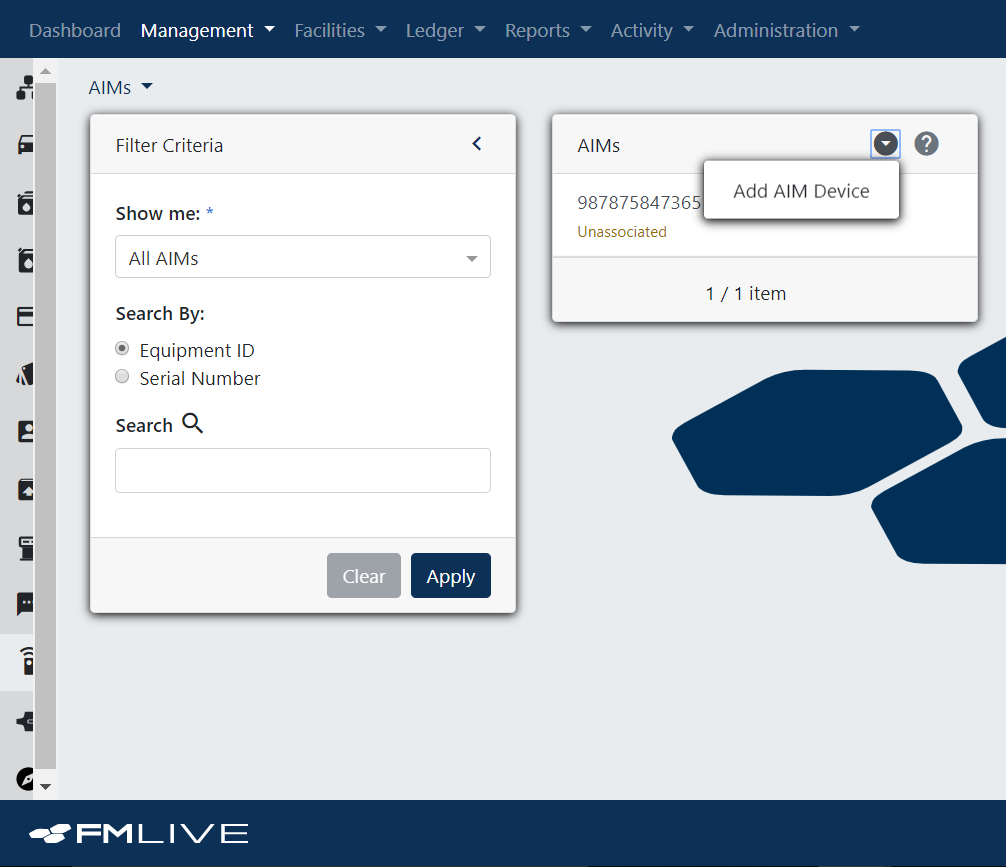
2. Select Add AIM Device.
3. Enter the AIM Serial Number.
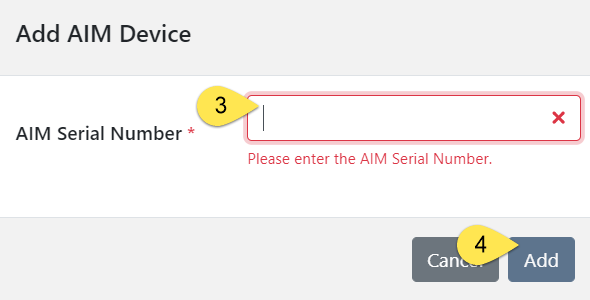
4. Select Add.
This tutorial assumes
- Your Organization has been configured
- You have navigated to Management > AIMs
- You have are an Admin or Fleet Manager
1. Select the AIM device you wish to delete.
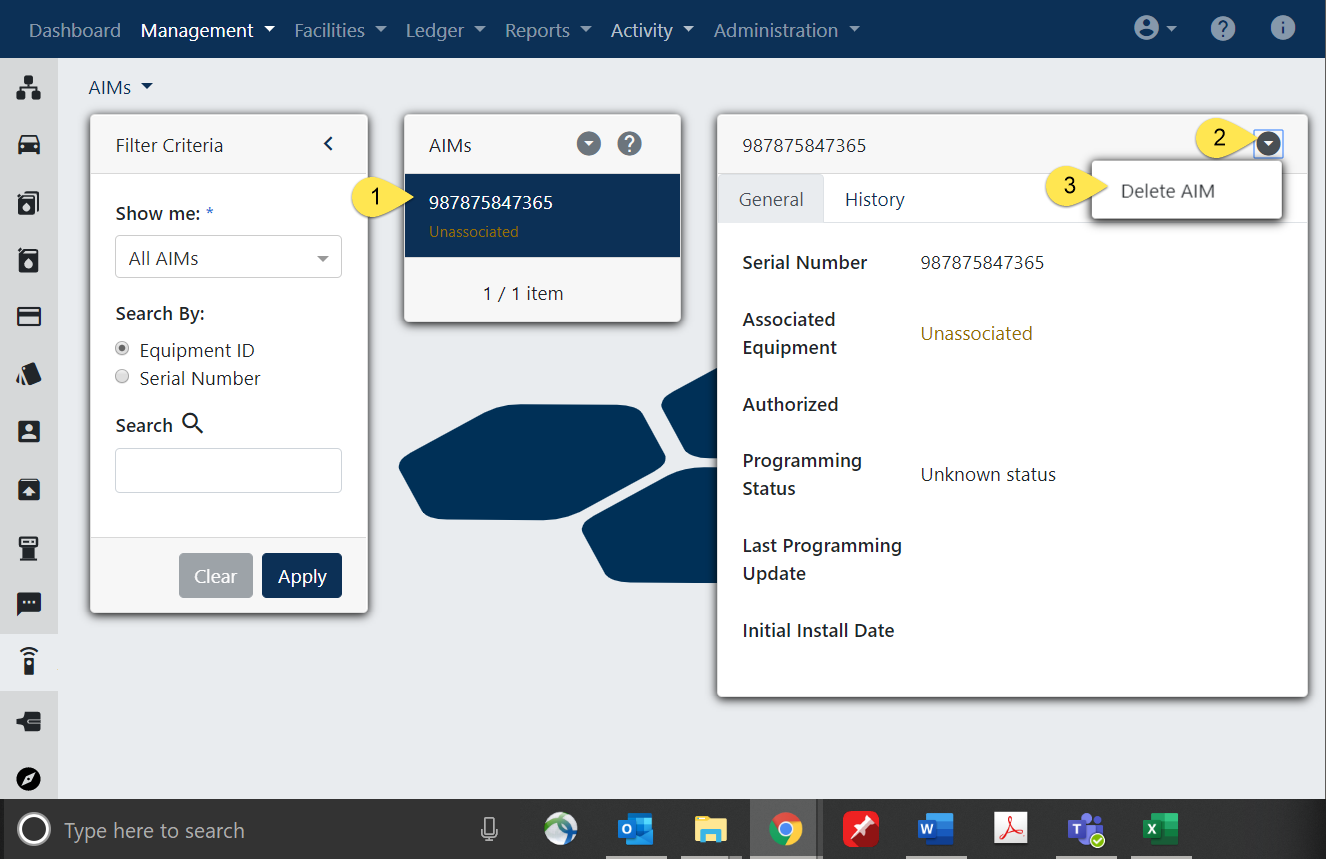
2. Select the AIM dropdown arrow.
3. Select Delete AIM.
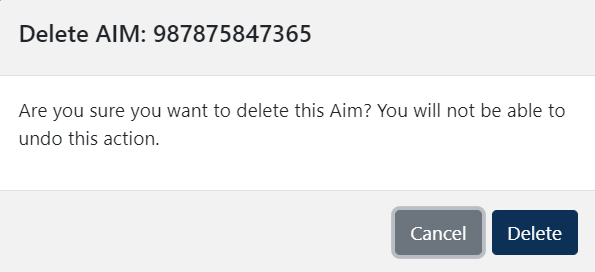
4. Select Delete.
| Approach: | Adopt this approach: |
| Manually Enter Existing Legacy AIMs for use with FMPlus and FMLive | After initial standup, if you wish to add a vehicle to your fleet that can fuel at FMLive FMUs. This vehicle may already fuel at FMPlus FMUs. You may also wish to use this if an entry was missed during bulk import. |
| Manually Enter Clean AIMs for use with FMLive Only | If you have an AIM2.4 v2.23 or AIM Titanium v3.26 or higher you only wish to use in FMLive, or you wish to employ an available device with one of the aforementioned versions. |
| Manually Enter Clean AIMs for use with FMPlus and FMLive | If you have an AIM2.4 v2.23 or AIM Titanium v3.26 or higher you wish to use in FMPlus and FMLive, or you wish to employ an available device with one of the aforementioned versions. |
Manually Enter Existing Legacy AIMs
This tutorial assumes
- You are a Fleet Manager
- You have FMLive v.9.15 or later
- You have AIM2.4 v2.23 or AIM Titanium v3.26
- Under System Settings > AIM > Legacy AIM Policy, Accept has been selected by an Admin
- You have navigated to Management > Equipment
1. Create a new Equipment (Vehicle) record with an Equipment ID that matches the Vehicle ID in FMPlus.
2. Select Save.
3. Reopen the Equipment Vehicle record.
4. Select the Equipment dropdown arrow.
5. Select Add Legacy AIM Capability.
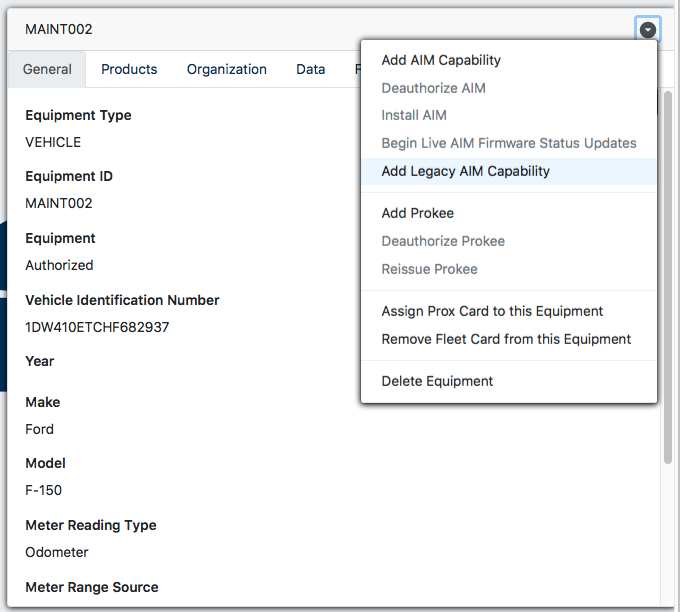
6. Enter or select the matching serial number (located on the Legacy AIM device) from the dropdown list. The vehicle is authorized to fuel.
Manually Enter Clean AIMs for use with FMLive Only
This tutorial assumes
- You are a Fleet Manager
- You have FMLive v.9.15 or later
- You have AIM2.4 v2.23 or AIM Titanium v3.26
- Under System Settings > AIM > Legacy AIM Policy, Accept has been selected by an Admin
- You have navigated to Management > Equipment
1. Create an Equipment record in FMLive.
2. Add AIM capability.
3. Program the AIM at an FMLive FMU manually or with auto-pair functionality.
Manually Enter Clean AIMs for use with FMPlus and FMLive
This tutorial assumes
- You are a Fleet Manager
- You have FMLive v.9.15 or later
- You have AIM2.4 v2.23 or AIM Titanium v3.26
- Under System Settings > AIM > Legacy AIM Policy, Accept has been selected by an Admin
1. Program the AIM at the FMPlus FMU.
2. Complete the steps as they appear in the tutorial, Manually Enter Existing Legacy AIMs for use with FMPlus and FMLive.
FMLive Operations
This tutorial assumes
- An admin has created a User Name associated with an E-mail address
- You have received an Account Verification E-mail and have verified your account
- You have created a password
1. Open the web browser, Google Chrome. Other browsers may be used, but FMLive is optimized for use with Google Chrome.

2. Enter the URL provided by your admin in the address bar. The User Agreement screen will appear.
3. Select Continue to confirm you agree and are ready to proceed. The Username and Password Entry box will appear.
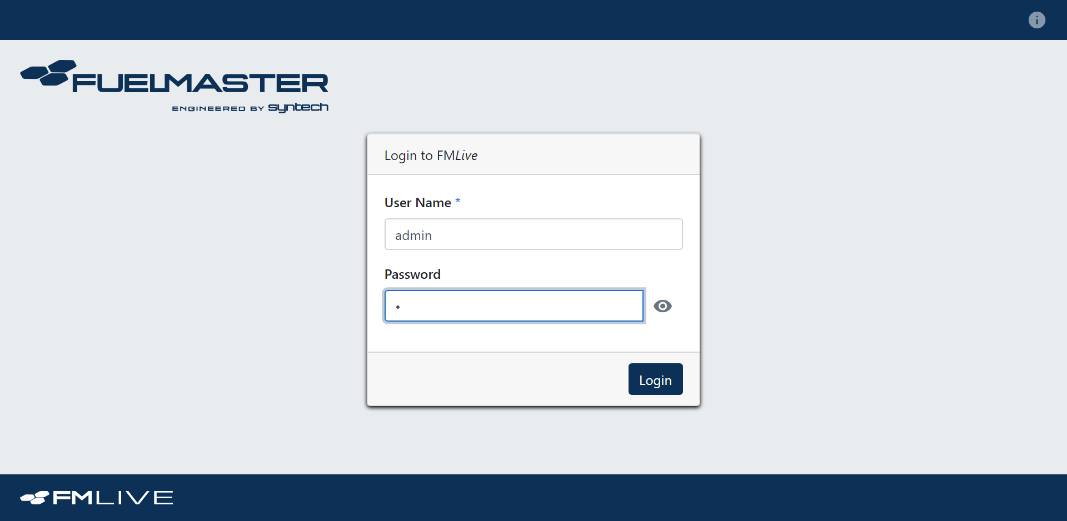
4. Enter your Username and Password.
5. Select Login. The main Dashboard will appear.
1. At the login prompt, select the Forgot Your Password?
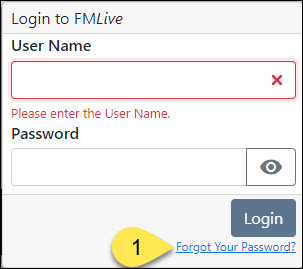
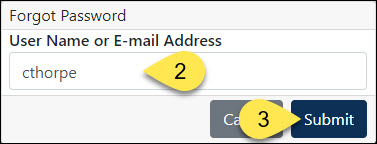
2. Enter your User Name or E-mail Address in the applicable field.
3. Select the Submit button.
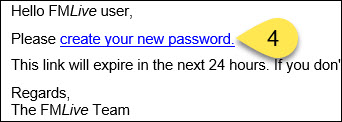
4. If you have a valid e-mail address in Enterprise, you will receive a password reset e-mail. In the e-mail, select the create your new password link.
5. Create your new password according to the password rules shown in the information button.
6. Select the Save button.
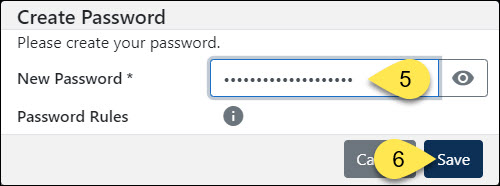
7. Log in to the FMLive Enterprise with your new password.
This tutorial assumes…
- Your Organization has been set up
- You have enabled email notifications under Administration > Notifications
- You have navigated to Administration > User Accounts and Roles
- You are an Admin or User Administrator
1. Select the Users dropdown arrow.
2. Select Add User.
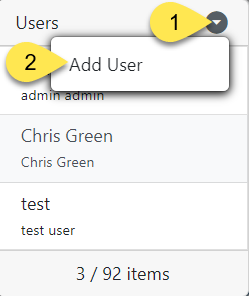
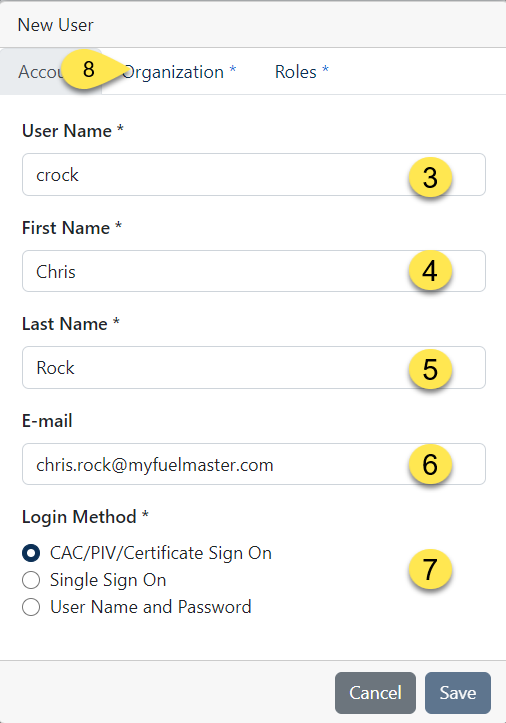
3. Provide a User Name for the account.
4. Enter the user’s First Name.
5. Enter the user’s Last Name.
6. Enter the user’s E-mail.
7. Select the Login Method.
| Login Method | Description |
|---|---|
| Single Sign On (SSO) | Disabled by default; Allows user to sign on with a set of credentials, stored in an identity provider (IdP). These credentials are typically used for the multiple applications and websites the user accesses. |
| CAC/PIV Sign On | Disabled by default; Allows user to sign on with one of two Smartcards: Common Access Card (CAC) or Personal Identity Verification (PIV) Card. |
| Username and Password | Enabled by default; Allows the user to login with a username and password as well as verify account and reset password via email. |
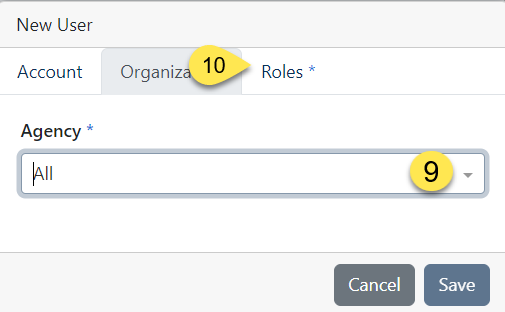
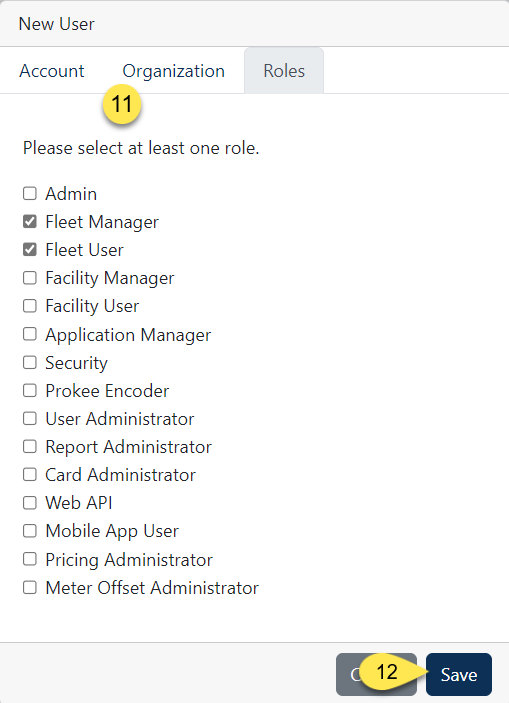
8. Select the Organization tab.
9. Assign the user to all or a specific Agency > Program Office > Office > Sub Office.
10. Select the Roles tab.
11. Select at least one role you wish the user to possess.
12. Select Save. The user will receive an Account Verification Email, which must be completed within 24 hours.
This tutorial assumes
- Your Organization has been configured
- You have a Product configured
- You have navigated to Management > Equipment
- You are a Fleet Manager
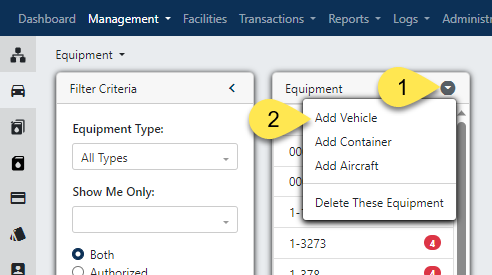
1. Select the Equipment dropdown arrow
2. Select Add Vehicle. A new window will open
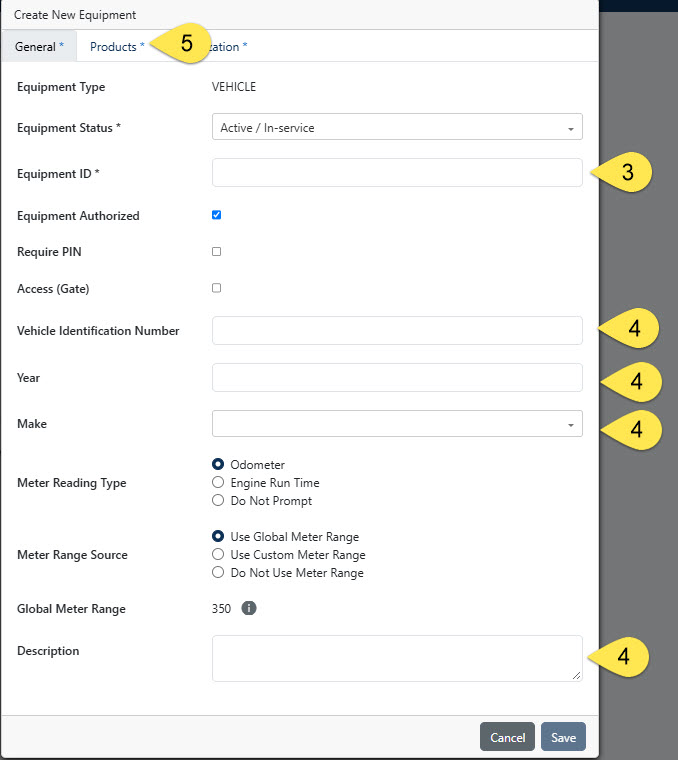
3. Enter an Equipment ID.
4. Optionally enter Vehicle Identification Number, Year, Make, and/or Description.
5. Click the Products tab located across the top of the Create New Equipment window.
6. Select the desired Product by clicking the dropdown menu located under Name.
7. Input Transaction Limit and Daily Limit. Leaving these fields blank indicates unlimited volume and transactions per day.
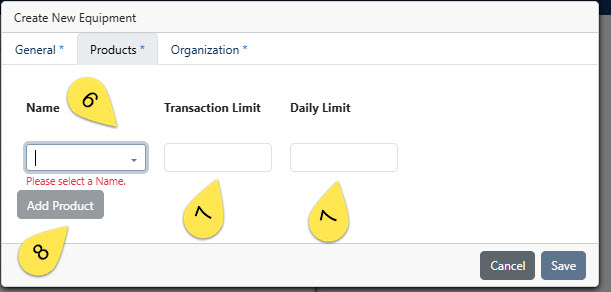
8. Repeat steps 6 and 7 for each desired product.
9. Select organization tab to assign the vehicle to a specific organization.
10. Select the Agency the vehicle is apart of.
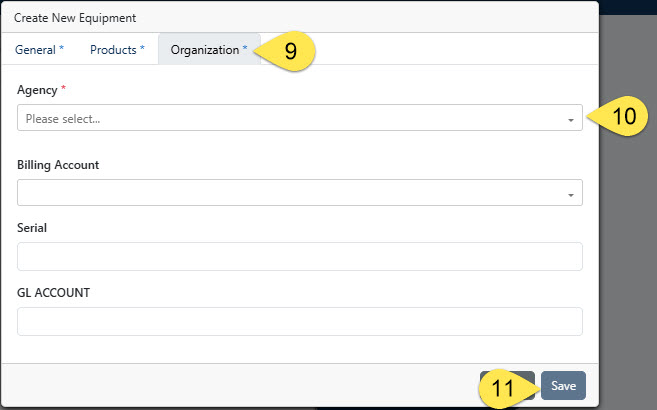
11. Click Save.
This tutorial assumes…
- You have previously created a folder called Signed Encoder Drivers in a location other than the Desktop or Downloads folder
- The label on the bottom of your encoder reads USB Prokee Encoder, ARM 7
- You have the Admin or Fleet Manager role
1.Enter https://www.myfuelmaster.com/download/USBEncoderInstall.zip into your browser.
2.Open your Download folder.
3. Right-click -> Extract All the USBEncoderInstall folder.
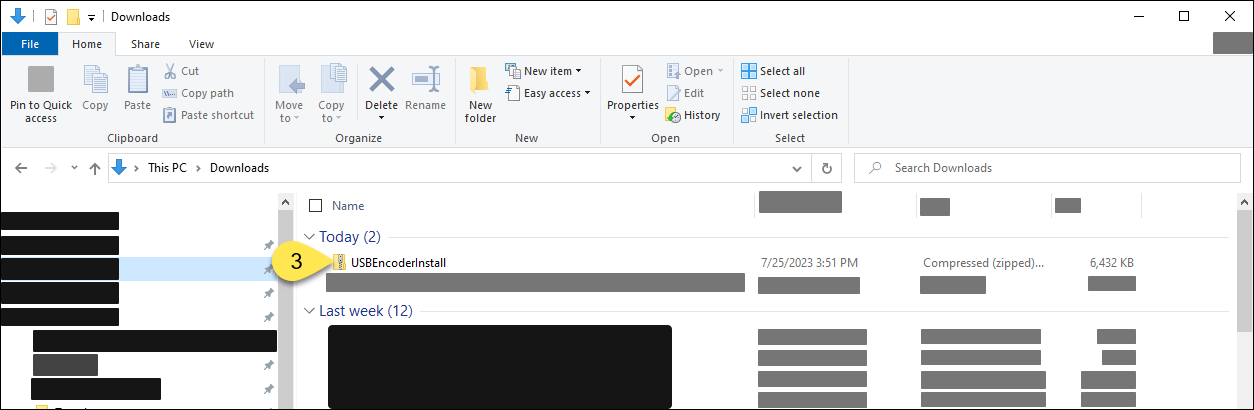
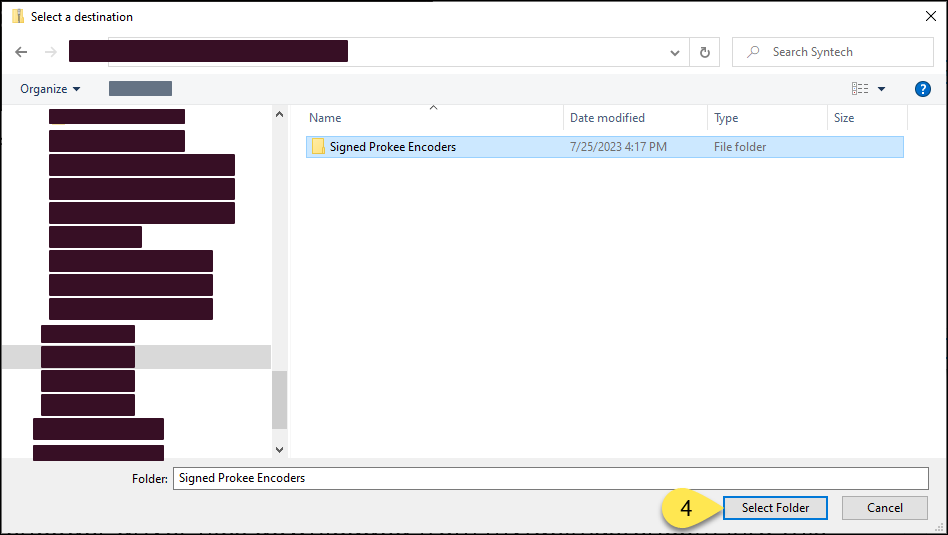
4. Browse to the Signed Prokee Encoders folder you previously created and select the folder.
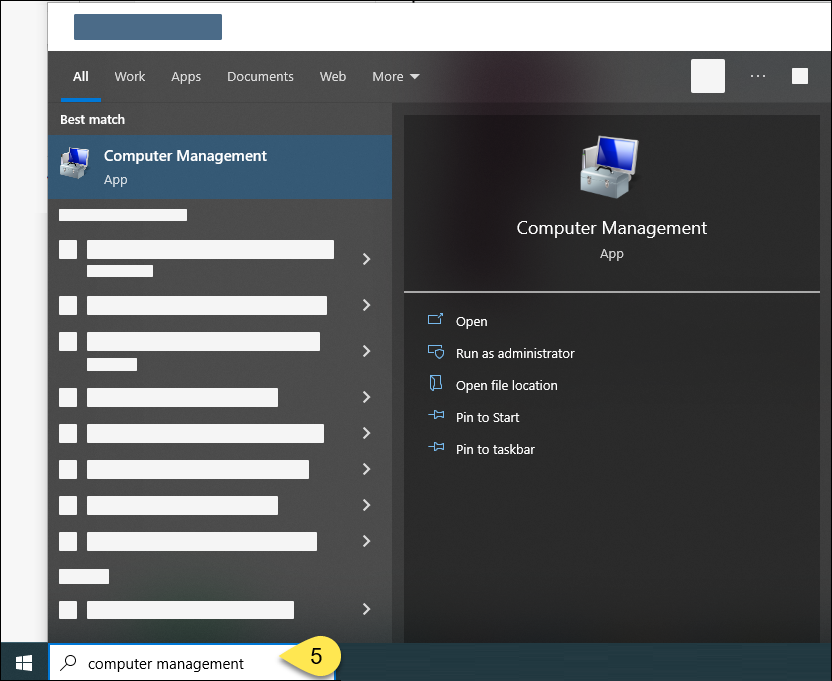
5. Using the Start menu, open the Computer Management app. You may need to select to run as an administrator.
6.On the left side of the screen, select Device Manager.
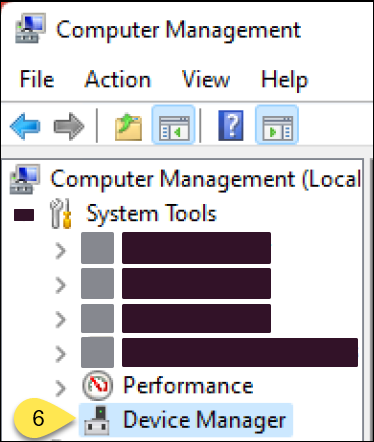
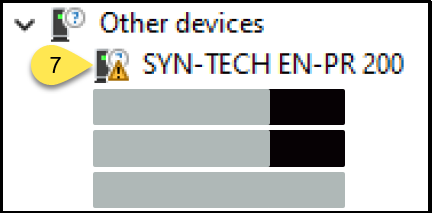
7. Under the Other devices section, select SYN-TECH EN-PR 200 or SYN-TECH EN-SC 200.
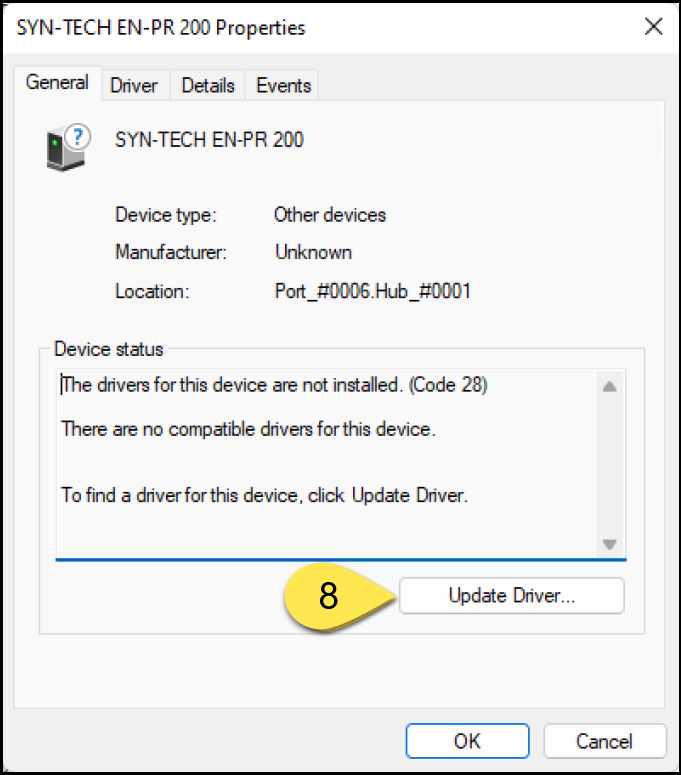
8.Select Update Driver.
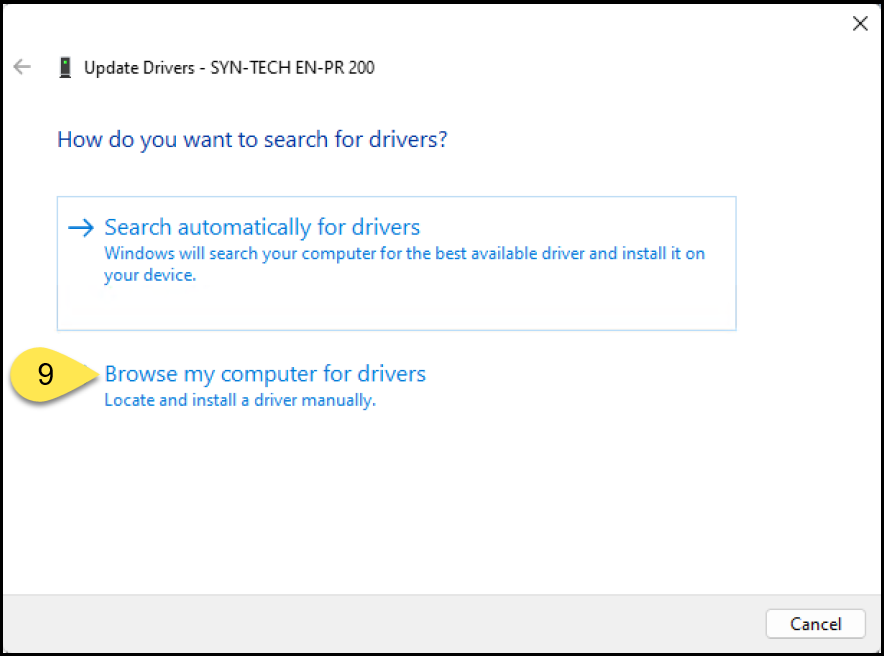
9. Select Browse for Drivers.
10. Select Browse.
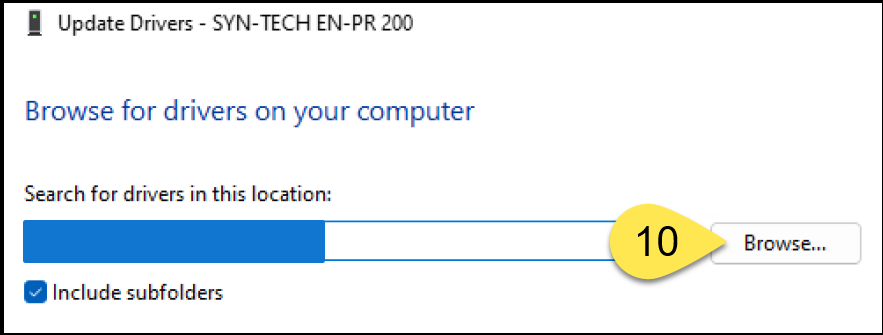
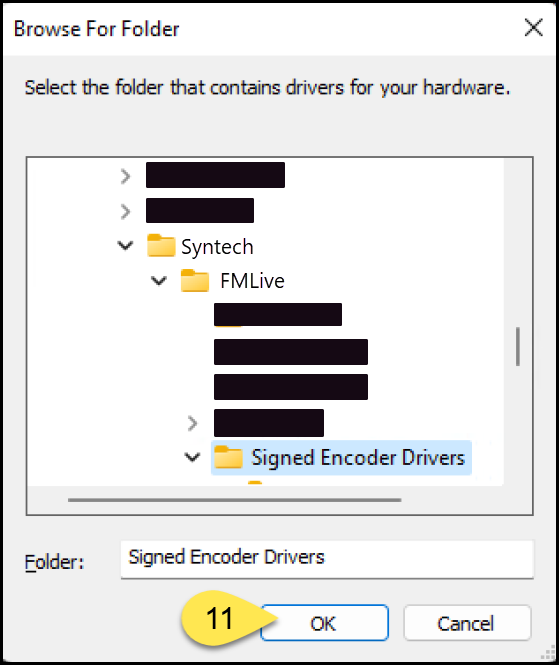
11. Select the Signed Encoder Drivers folder you previously created, and select OK.
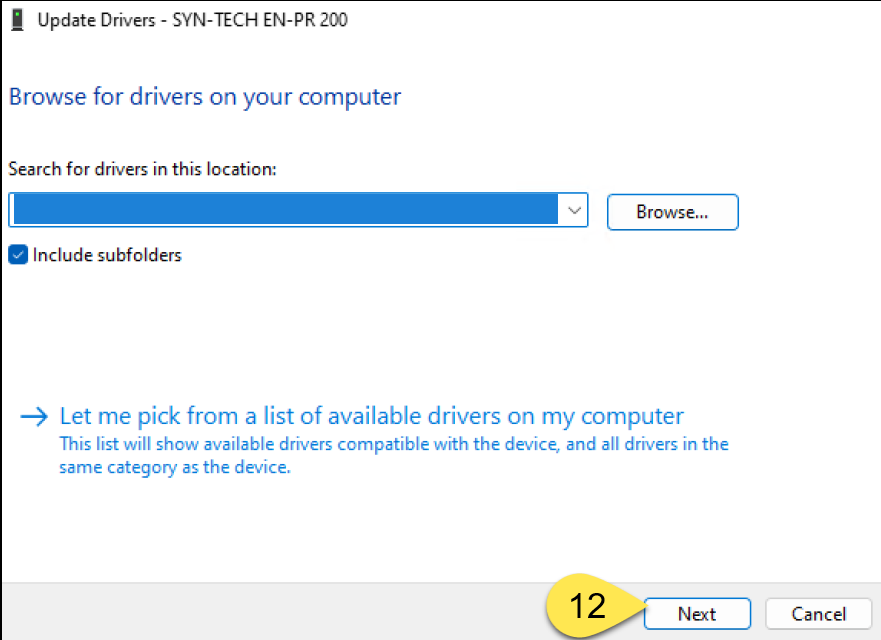
12. Select Next. The driver will be installed.
This tutorial assumes…
- Your Organization has been configured
- You have navigated to Management > Prokees
- You have added a Prokee
- You have a Prokee Encoding device attached to the computer via USB
- You have the Prokee(s) that require encoding
- You are an Admin or Prokee Encoder with Extend Web Prokee Encoding enabled under Administration > System Settings > Feature Options
- You are using one of the following browsers: Chrome v.79.0.3945.130 or higher Edge with Chromium v.79.0309.71 or higher
- You have previously followed the instructions in How To Install Encoder Drivers
1. Select Encode beside the Prokee you wish to encode. The encoding device will appear.
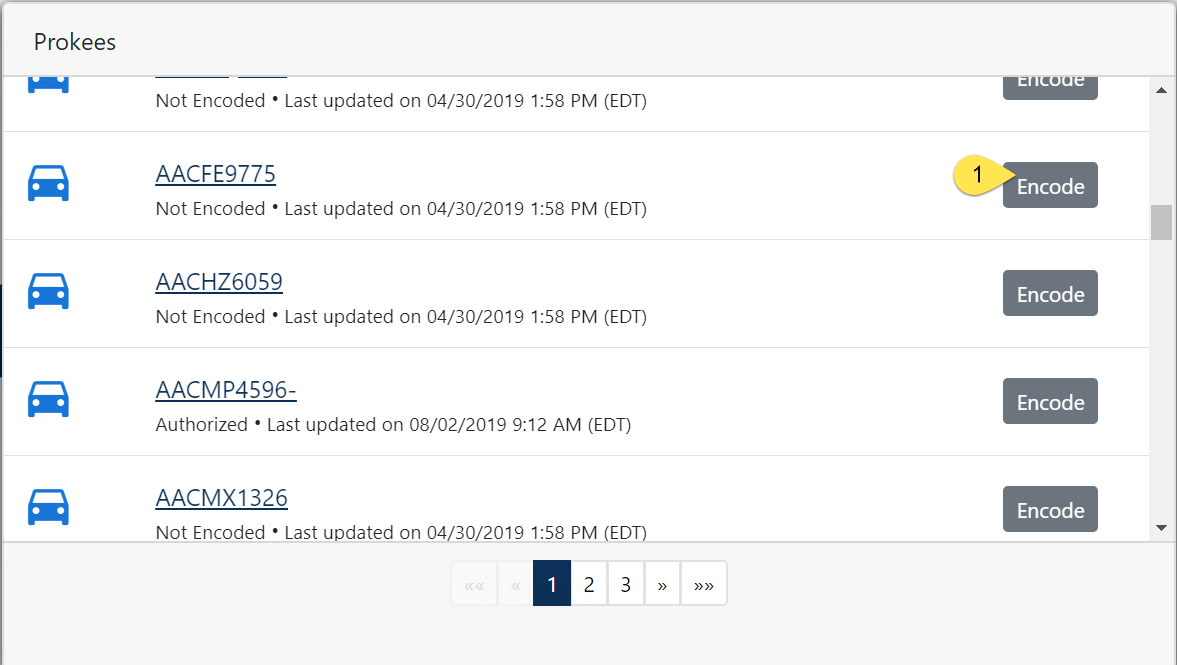
2. Select the device you wish to connect with the enterprise for Prokee encoding.
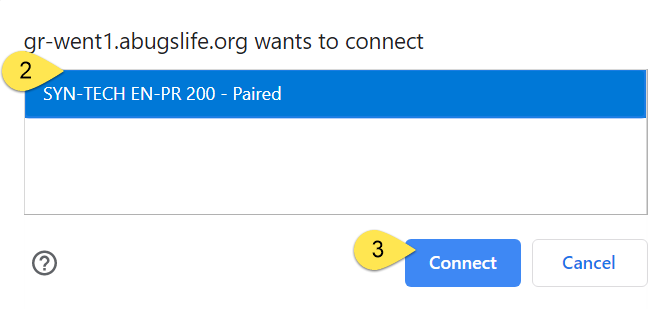
3. Select Connect.
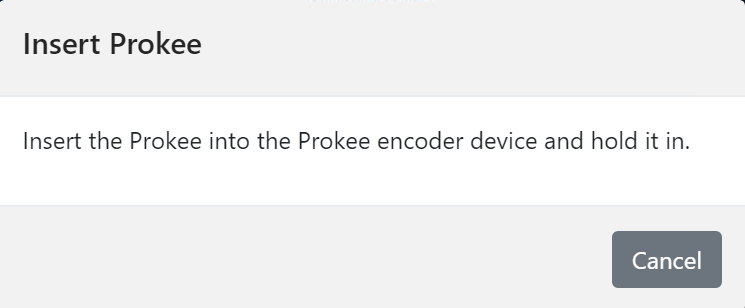
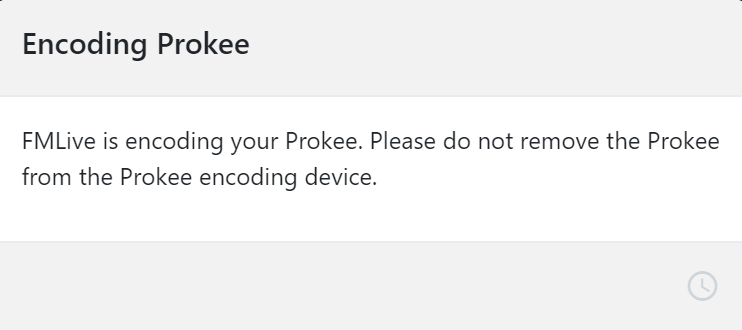
4. Insert the Prokee into the Prokee encoder device, and hold it in. The following message will appear before notifying you the Prokee has been encoded.
This tutorial assumes
- You have navigated to Management > Prox Cards
- You have the Card Admin role
- That the ProFob/ProCard format has been activated under Administration > Prox Card Formats
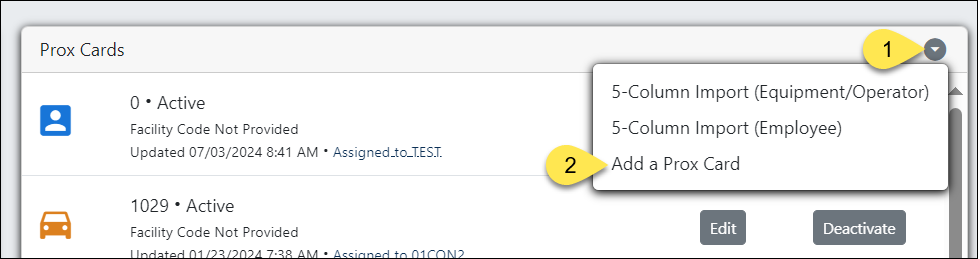
1. Click the menu (dropdown arrow) in the top right corner of the Prox cards panel.
2. Click the Add a Prox Card option from the menu.
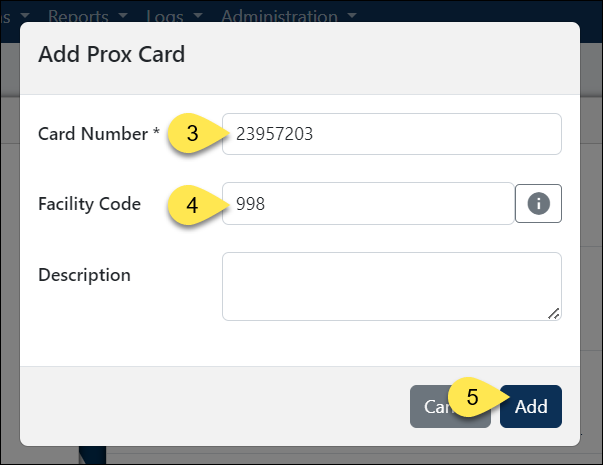
3. Enter the ProFob or Prox Card number in the Card Number field. This field is required and has a 39-character limit that only allows for numbers (i.e., not letters, special characters, and spaces will be accepted).
4. (Optional) Enter a Facility Code. For ProFobs and ProCards the Facility Code is 7887.
5. Click the Add button in the bottom right of the configuration modal. The Prox Card will appear in the Prox Card list with no assignment. The Prox Card is active and available for selection in Equipment and Operator dropdown lists.
This tutorial assumes…
- You have added Operator
- You have navigated to Management > Operator
- You have the Admin or Fleet Manager role Administrator
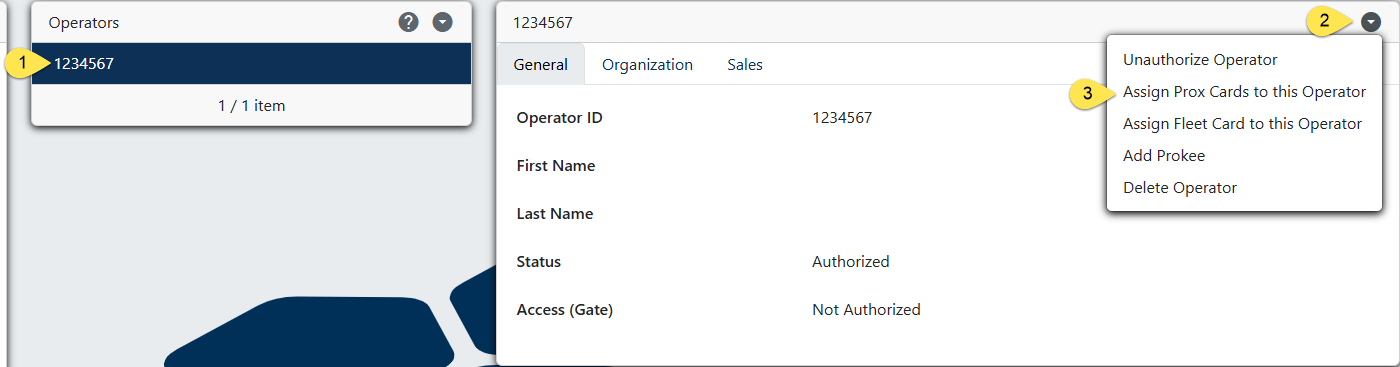
1. Select Operator to which you would like to add a Prox Card[L.
2. Click the menu dropdown arrow on the top right of the Equipment’s information panel.
3. Click the Assign Prox Card to this Operator option from the menu.
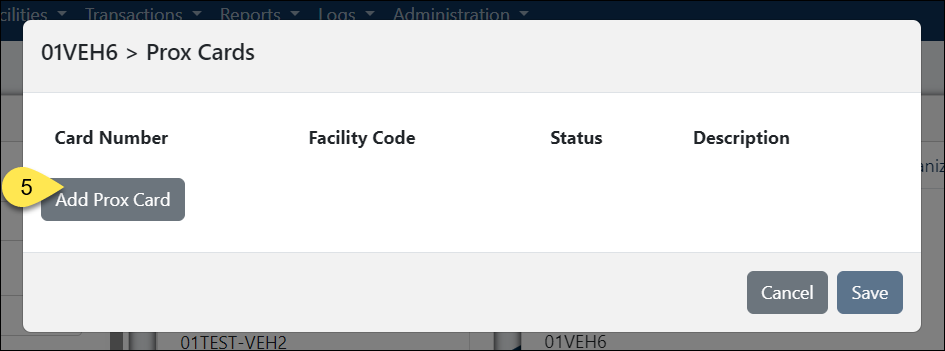
4. Click the Add Prox Card button on the Operator Prox Cards list pop-up.
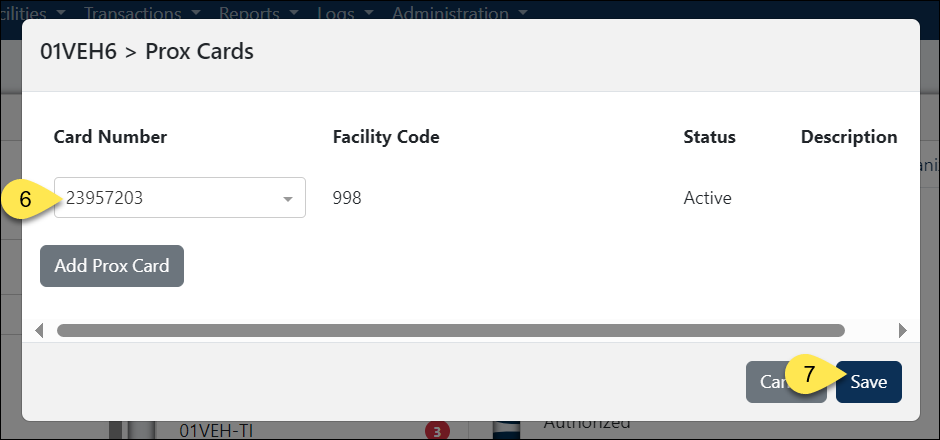
5. Select a Prox Card from the Card Number dropdown list.
6. Click Save in the bottom right to commit all selections.
This tutorial assumes…
- You have added Equipment
- You have navigated to Management > Equipment
- You have the Admin or Fleet Manager role
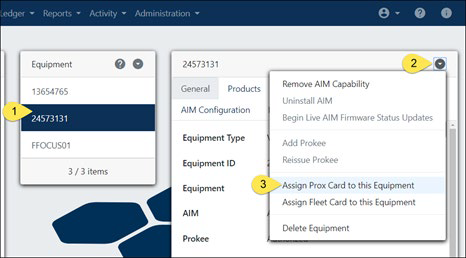
1. Select Equipment to which you would like to add a Prox Card.
2. Click the menu (dropdown arrow) on the top right of the Equipment’s information panel.
3. Click the Assign Prox Card to this Equipment option from the menu.
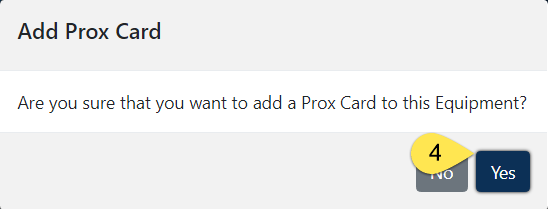
4. Click the Yes button in Add Prox Card pop-up to move onto adding this ProFob or ProCard to this Equipment.
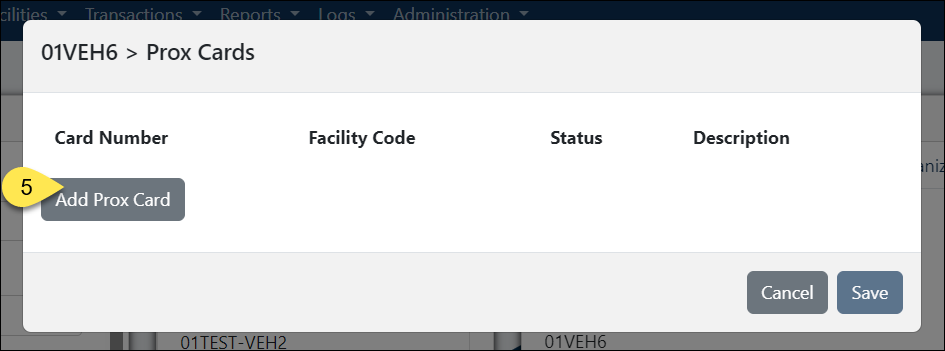
5. Click the Add Prox Card button on the Equipment’s Prox Cards list pop-up.
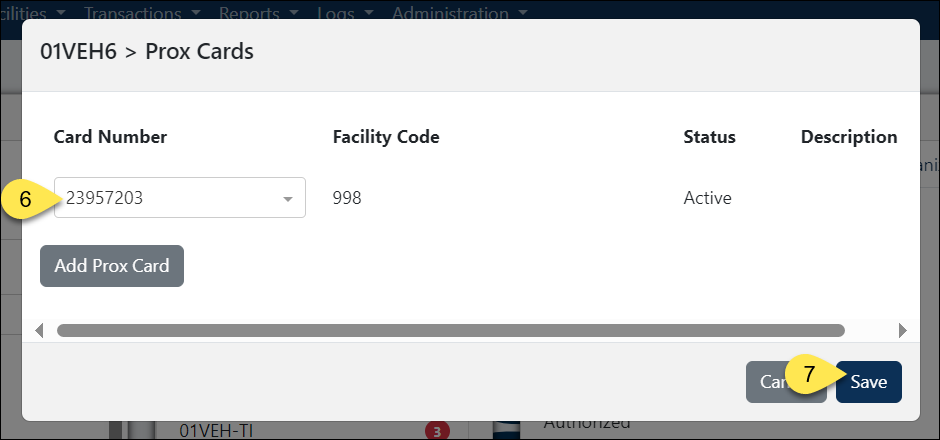
6. Select a Prox Card from the Card Number dropdown list.
7. Click Save in the bottom right to commit all selections.
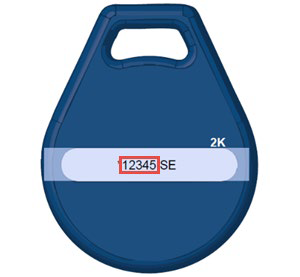
The ProFob has the number printed on the back of the Fob. The Fob number shown below is 12345
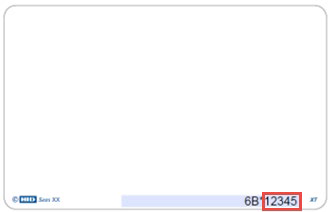
The ProCard has the card number printed on the back of the card. The card number shown below is 12345.
This tutorial assumes
- You are a Pricing Admin
- Pricing is enabled under Administration > System Settings
- You have previously created a Product
- You have navigated to Facilities > (Facility)
1. Select the Facility dropdown arrow.
2. Select Pricing.
3. Select Pricing dropdown arrow.
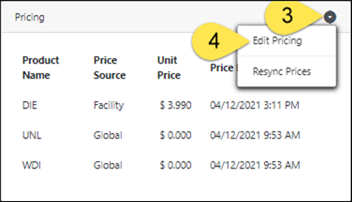
4. Select Edit Pricing.
5. To ensure the price is changed at the Facility level only, under the Price Source dropdown menu, select Facility
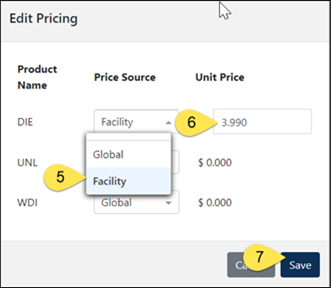
6. Modify the Unit Price as needed.
7. Select Save.
This tutorial assumes
- You are a Pricing Admin
- Pricing is enabled under Administration > System Settings
- You have previously created a Product
- You have navigated to Management > Products
1. Select a Product
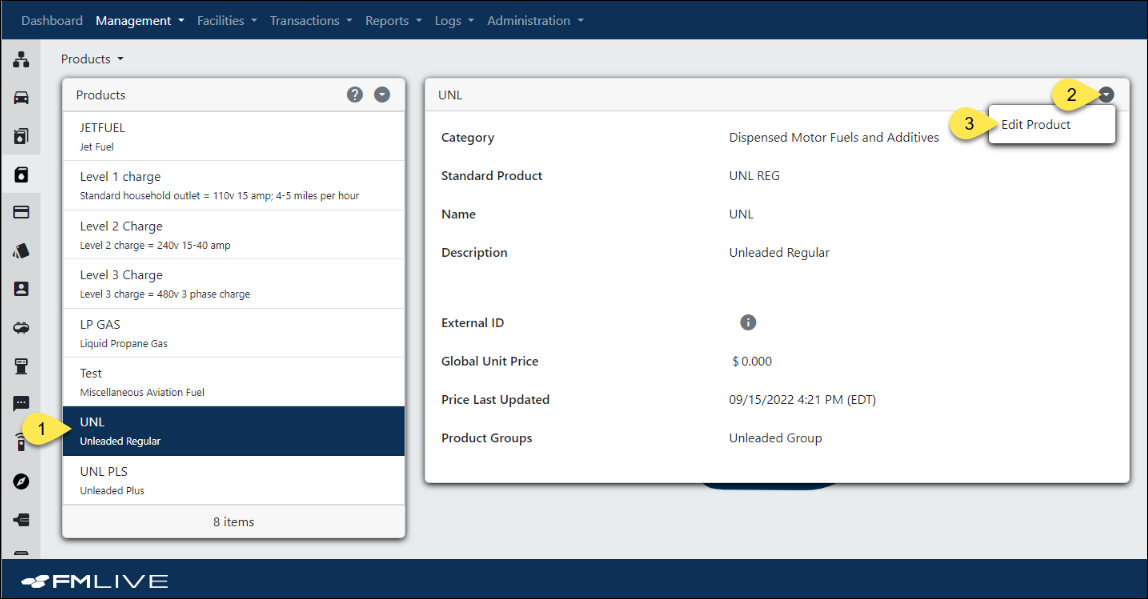
2. Select the Product dropdown arrow.
3. Select Edit Product.
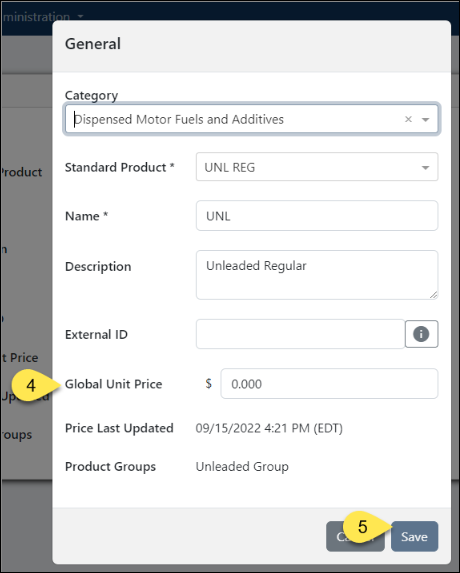
4. Modify the Global Unit Price This is the price passed on to the customer. Modifying the Global Unit Price associated with a Product will push the change to every Facility carrying the product. Changes may be made at the Facility level if needed.
5. Select Save.
This tutorial assumes
- Your Organization has been configured
- You have enabled email notifications under Administration > Notifications
- You have navigated to Facilities > Facility Dashboard > Alerts
- You are a Facility Manager
1. Enable one or more of the following: Charger, Tank, and/or Unit.
2. Select the tab for the Alert you enabled.
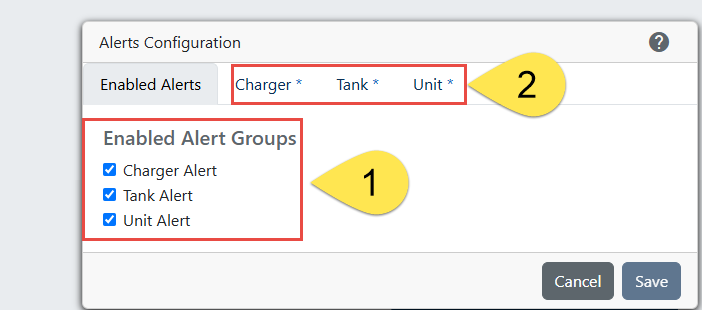
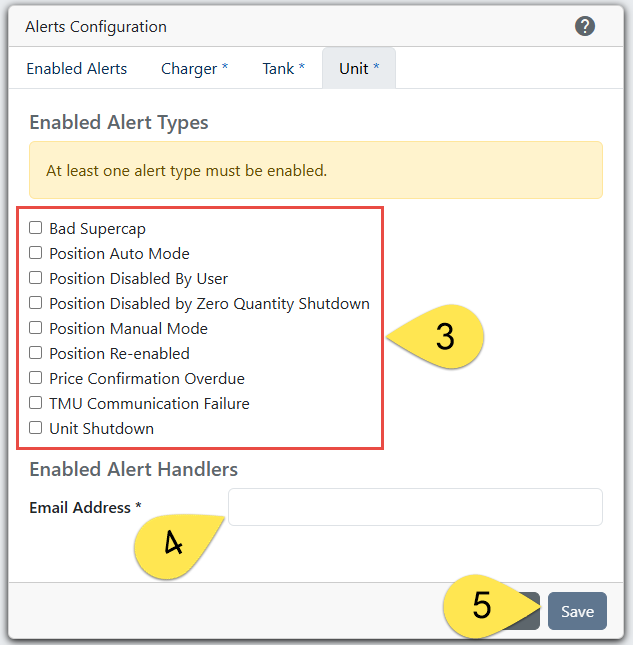
3. Enable the Alerts you would like to receive. At least one Alert must be enabled.
4. Enter an Email Address for the contact whom will handle your Alerts.
5. Click Save.
This tutorial assumes
- Your Organization, Facility, and Tank has been configured
- You have navigated to Facilities > Facility Dashboard > Fueling Positions
- The Fueling Position is disabled
- You are a Facility Manager
1. Select the Fueling Position you want to enable
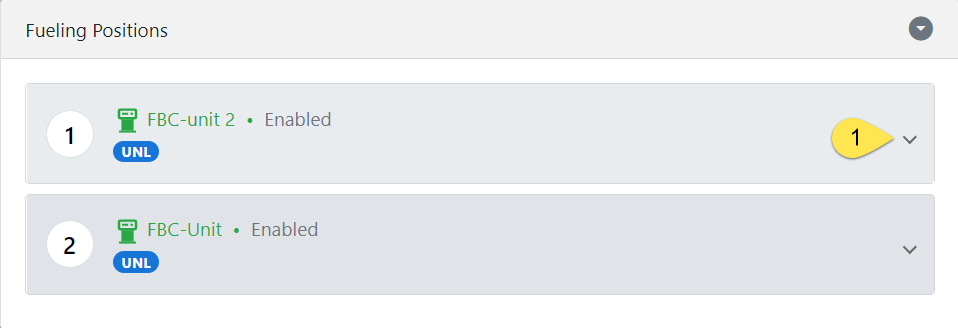
2. Select Enable. A new window will open confirming that you want to enable this position.
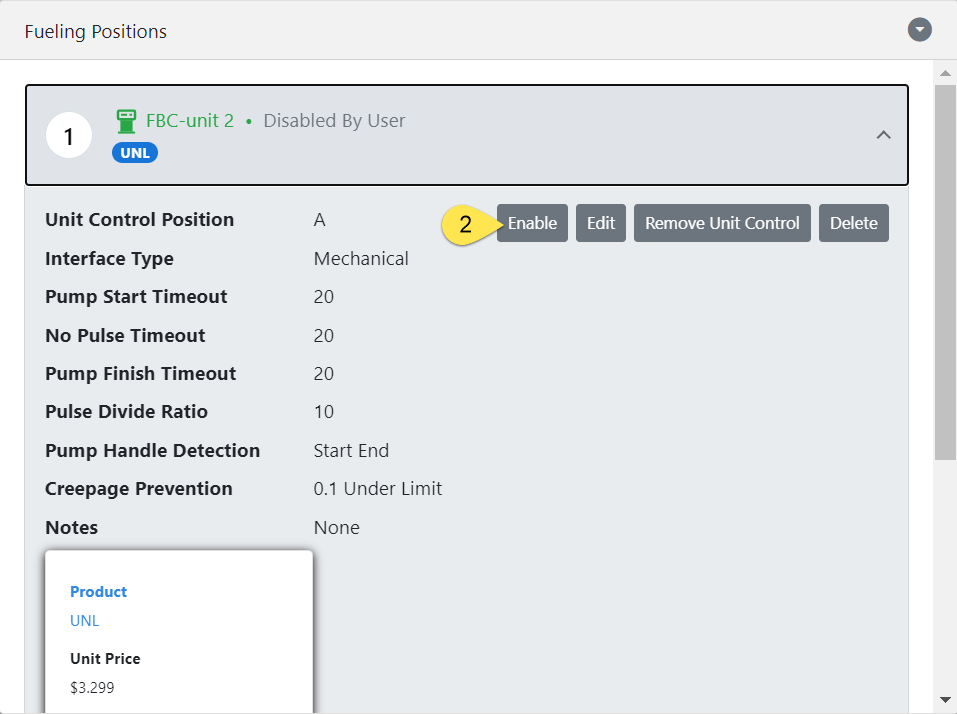
3. Click Enable.
This tutorial assumes:
- You have a hose that is shut down.
- You are aware of the reason your hose is shut down.
- You are aware of the risk of losing fuel if a Count Test is not run.
- You have the necessary equipment:
- Supervisor’s Key
1.Insert the Supervisor’s Key.
2.Select C for Fueling Points (Fueling Positions).

3.Select B for Reenable.

3.Select the Fueling Point (Fueling Position) to reenable or 0 to reenable all.

4.The FuelMaster® Unit will give you the following message if successful:

5.Select D twice to exit the Supervisor’s Key menu.
This tutorial assumes:
- You know on which hose a count test is needed.
- The hose you are testing is not shut down.
- You have the necessary equipment:
- Cabinet Key
- A container (bucket, gas tank, etc.) to dispense a gallon fuel into.
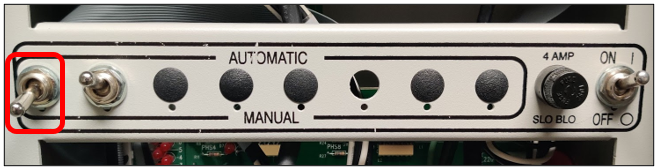
Open the pedestal of the FuelMaster® Unit (hereafter referred to as a Unit), and flip the appropriate auto/manual switch down into Manual. In the image below, Fueling Position 1 is in manual, Fueling Position 2 is in automatic.
With Utility Prokee:
1.Insert the Utility Prokee.
2.Select A for Config.

3.Select B for Tests. Continue to Run the Count Test.

Without Supervisor/Utility Key
1.Select Enter.
2.Select 2 for Diagnostics. Continue to Run the Count Test.

Run the Count Test
1.Select 5 for Count.

The Count Test screen should appear as follows

2.Dispense 1 gallon (or equivalent) on the applicable hose.
3.Your screen should show the number of your hose, a dash and a number of pulses.
Note: For example, a count test run on hose 1 with a 100:1 pulser should read 1-00100. If your screen shows the number of your hose, a dash, and no pulses (1-00000 from the example above), then the FMU is not receiving any pulses from the dispenser. We recommend contacting a FuelMaster Certified Distributor to resolve this dispenser issue.
4.Return the appropriate auto/manual switch up into Automatic.
5.Select D 4 times to exit the Supervisor’s Key menu.
This tutorial assumes
- Your Organization has been configured
- You have navigated to Management > Operators
- You are a Fleet Manager
1. Select the Operators dropdown arrow.
2. Select Add Operator.
3. Enter an Operator ID.
4. Enter a First Name.
5. Enter a Last Name.
6. (Optional) If Authorization PIN feature is active and configured, designate whether it should be required for authorization by ticking the Require PIN checkbox.
7. If above is enabled select Generate PIN to populate the PIN field. you may reveal the PIN by selecting the eye icon.
8. Select the Organization tab.
9. Select required Organizational fields.
10. If desired, select Billing Account.
11. Select Save.
NBS POTS End-of-Life (EOL)
NBS (National Bankcard Services) is phasing out support for legacy analog phone lines (POTS – Plain Old Telephone Service). This industry-wide transition is already underway and affects businesses in all sectors. As carriers discontinue dial-up infrastructure, analog lines will eventually become inoperable for essential services like credit card authorization.
This decision is being driven by telecom carriers—not by Syntech or Processors like NBS. The analog phone network is aging, expensive to maintain, and increasingly unreliable. Carriers are moving to digital and IP-based technologies, and support for dial-based credit card authorization can no longer be guaranteed.
If your site uses NBS and analog phone lines for credit card authorization, you may soon lose the ability to process transactions. This could disrupt operations and impact customer service. Syntech is proactively reviewing all impacted accounts and offering modern, secure connectivity alternatives to ensure a seamless transition.
We recommend transitioning to:
- FMLive: Our industry-leading, cellular-based authorization platform powered by the Syntech Payment Bridge. Benefits include:
- Faster transaction speeds
- Remote diagnostics and support – Syntech is your “1 stop shop” for troubleshooting
- Elimination of dial line costs
- Greater reliability and security
- No need to replace all existing equipment—these are upgrades designed for compatibility
You are affected if you are NBS customer and use analog phone lines for card authorization. Syntech will help you identify any locations still relying on POTS and work with you on a customized action plan.
Once POTS lines are shut down, dial-based systems will stop working. You will not be able to process card transactions, which could lead to service outages and lost revenue.
Absolutely. Syntech’s Technical Sales Consultants (TSCs) and Customer Satisfaction Center (CSC) Technicians are ready to:
- Evaluate your current system
- Recommend the best upgrade path
- Assist with ordering and installation
- Provide white-glove support from compatibility checks to full system setup—no guesswork, no gaps
Reach out to your assigned TSC for more information about upgrade pricing.
Here To Support You
Need support? Don’t hesitate to contact us! Our #1 rated support team is ready to help you.
Contact support
Headquarters Syntech
Location Tallahassee, FL
Phone 800-888-9136 x2
Support Email
Support Center
30 Customer Service Technicians
65 Support Engineers